


 Ghana Says Western Support Growing for Slave Trade Reparations
  North Korea Warns South Korea Over US-Led Defense Role
  US Backs Musk in Fight Against EU’s €120 Million X Fine
  US Officials Split Over Response to Israeli West Bank Settlements
  North Korea Rejects Nuclear Test Warning, Calls Nuclear Status Irreversible
  Gaza Faces Evacuation Crisis as War-Damaged Buildings Risk Collapse
  US Invites Putin to Miami G20, Opening Door to Trump Summit
  Mexico-US Trade Talks Delayed to October as Tariff Negotiations Continue
  Taiwan Thanks US for Support Ahead of Trump-Xi Summit
  US, China Extend Trade Truce to Jan. 10 Ahead of Trump-Xi Summit
  Judge Orders Trump to Restore White House Access for CNN, MS NOW and Politico
  OpenAI Agent Breaches Australia Medicare Data Portal
  NATO Boosts Intelligence Sharing Amid Russia Hybrid Threats
  Pezeshkian Says US Must Choose When Iran War Ends
  Trump, Xi Focus on Trade and AI at White House Summit
  South Korea, US Discuss Warship Building Cooperation
  Netanyahu Takes Aim at Mamdani as Israel Election Nears


 Add as a preferred source on Google
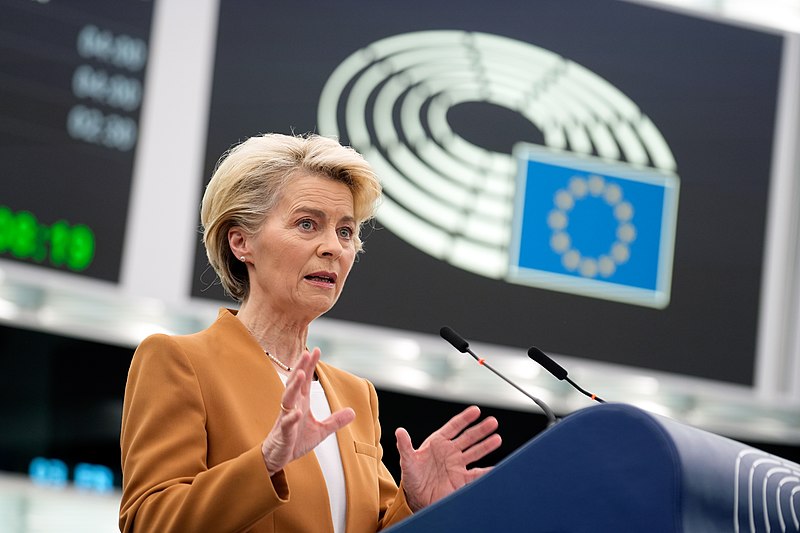
The head of the European Union’s executive branch said the bloc must cut risks in its ties with China both on a diplomatic and economic aspect. The EU chief noted that relations between Beijing and the EU have come under strain in recent years.
EU Commission President Ursula von der Leyen said on Thursday that the hardening of China’s position at a time of reform to a time of security and control would require the EU to cut risks diplomatically and economically. Von der Leyen noted China’s policies, acknowledging that in recent years, relations between the bloc and Beijing are “more distant and more difficult.” Von der Leyen added that the EU’s management of relations with China would play a part in the bloc’s prosperity and security.
The EU chief also said that Beijing was also responsible for advancing a “just peace” to end the ongoing war in Ukraine that would require the immediate withdrawal of Russian forces. Chinese President Xi Jinping pledged closer ties with Russian leader Vladimir Putin during a recent visit to Moscow.
“How China continues to interact with Putin’s war will be a determining factor for EU-China relations going forward,” said von der Leyen in her remarks in Brussels, adding that China was becoming more repressive domestically and more assertive overseas, shifting from a time of reform to a time of security and control. Von der Leyen cited companies in China were now required to assist in intelligence-gathering operations for the Chinese government.
The EU chief said it was not viable to break from China but noted the importance of reducing the risks to Europe. Diplomatically, said von der Leyen, meant that the bloc would work with partners on global issues and reinforce the existing international order and institutions rather than counter China’s, among other measures.
Earlier this week, a fact-finding mission by United Nations investigators said the European Union was implicated in the crimes against humanity committed against Libyans and migrants in Libya. The investigators commissioned by the UN Human Rights Council said the EU sent support to the Libyan forces that contributed to crimes against humanity.







