


 How to support someone who is grieving: five research-backed strategies
  Can your cat recognise you by scent? New study shows it’s likely
  Chinese Chip Stocks Surge on AI Boom and Domestic Tech Push
  Disaster or digital spectacle? The dangers of using floods to create social media content
  Taiwan Court Fines Tokyo Electron Unit $4.78M in Major TSMC Trade Secrets Case
  Mercedes-Benz Faces Rising Competition in China but Rejects Price War Strategy
  PLS Reports Record Lithium Output as EV Demand Fuels Market Growth
  Why Global Web3 Projects Can't Afford to Skip South Korea: TokenPost Unveils Data-Driven Entry Solutions
  Want to cut your energy bills? Here’s how five experts are doing it
  U.S. Raises Alarm Over Chinese AI Firms’ Alleged IP Theft Through Model Distillation
  Yes, government influences wages – but not just in the way you might think
  Britain has almost 1 million young people not in work or education – here’s what evidence shows can change that
  Sun Pharma to Acquire Organon in $11.75 Billion Deal to Boost Global Women’s Health Portfolio
  Booked to travel through the Middle East? Here’s why you shouldn’t cancel your flight
  The ghost of Robodebt – Federal Court rules billions of dollars in welfare debts must be recalculated
  Hyundai Plans 20 New Models in China to Boost EV Strategy and Market Share
  Debate over H-1B visas shines spotlight on US tech worker shortages



As the global population grows, it has been estimated that by 2030 the world will need more than 600 million new jobs. Many of these will be required in developing countries, where young people already struggle to find work, pay is low, and working conditions are often poor.
With few opportunities for decent work, many of the world’s poorest young people are self-employed or start their own businesses. Indeed, the World Bank considers small- and medium-sized enterprises (SMEs) to be a key element of new employment opportunities in lower-income economies.
But starting a business anywhere is fraught with risk. Failure rates are as high as 75% in Ethiopia and Rwanda, 74% in Ghana, and 67% in Zimbabwe.
Failure is more likely where interest rates are high and when prospective entrepreneurs lack collateral, which blocks proper financial support – a vital part of the survival of new businesses and the new jobs they can create.
Unfortunately, secure financial support is not as widely available as it might be. In developing countries, just 15% of young people have saved money with a formal financial institution. Our survey highlights the varied experiences of young people (under 35) from low-income communities using financial services.
And it’s not only support for start-ups that our survey shows is lacking – we also saw a more basic failing of the financial sector for individuals, and particularly women.
Many of the people we surveyed (from 21 countries including Sri Lanka, Sierra Leone and Malaysia) preferred to take a more informal route to getting money. Around 83% said they turned to their family for financial support, 16% to community savings schemes, and 9% to informal money lenders.
For some, the financial services (both informal and via traditional banks) they receive have a positive impact – but for others, they can be ruinous. The failure to pay back loans can lead to some young people fleeing their homes.
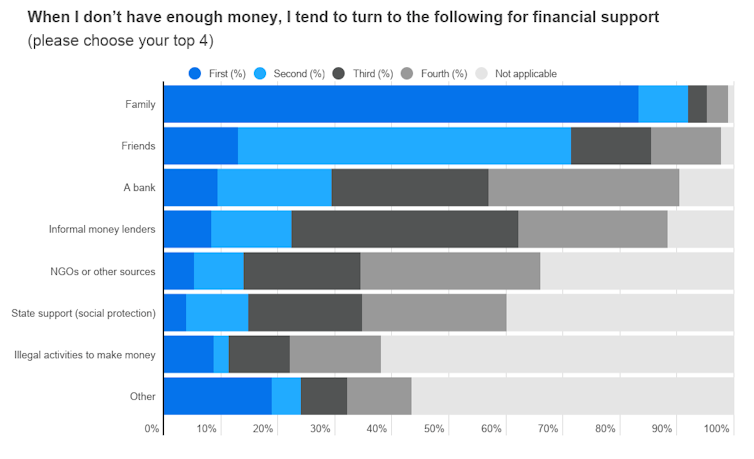
What our respondents told us about where they seek financial help. Author provided
And while formal finance might seem like the safer option, we found a widespread lack of trust in formal financial services. Most (62%) did not want to get involved with formal banking, while nearly a third (30%) had little money to spend and nothing to save, rendering financial services irrelevant. Almost half (45%) had never considered traditional financial products and services to be relevant.
Other major barriers to formal banking include lack of documentation or collateral. There may also be prohibitively high interest rates to contend with.
Overall, our survey indicates that young people value the security and predictability that banks can offer, but often consider these benefits to be out of their reach.
Compared with older adults, young people are 33% less likely to save in general, and 44% less likely to have a formal savings account. Nevertheless, research indicates that prioritising savings, however small, over loans enables young people to create digital savings records and build good financial habits.
Making small, consistent savings significantly contributes to young people’s, and particularly women’s, financial empowerment. Research across sub-Saharan Africa and South Asia shows that both financial and digital literacy are key to boosting economic resilience.
Financial health
The situation is a problem for the banks too. For them – and businesses generally – the growing youth population in emerging economies represents a relatively untapped market of millions of potential customers, clients and staff.
When it comes to providing loans, high interest rates are often justified due to the risk of lending, but it is time to rethink this approach.
For example, do banks have to treat young entrepreneurs as really high risk? Can assessment criteria be more flexible for young prospective customers? And could new forms of assessing credit, based on building a financial and savings history rather than on access to collateral, be accepted from those previously excluded?
Credit can support a young person’s growth – or ruin them by depleting their financial health. For instance, research into new digital borrowing schemes saw high levels of late payment, with 31% of borrowers defaulting in Tanzania and 12% in Kenya.
Other research shows that the type of credit matters. Long-term business loans improve financial health, whereas immediate credit to meet day-to-day needs tends to be detrimental.
Making financial health the new goal would mean supporting people towards financial stability – to get to a point where they can withstand financial shocks and feel secure.
Young people will grow up in the unfolding climate crisis, which our research shows is already disrupting lives and livelihoods. They need banks to seriously rethink what they are offering. A wider uptake of formal financial services could provide young people in developing economies with a safer way to build and grow the businesses that will create some of those 600 million new jobs.







