


 New Mexico Measles Outbreak Cost Reached $5.4 Million, Study Finds
  Hanmi Pharm Soars 30% on $2.3 Billion Genentech Obesity Drug Deal
  Venezuela Earthquake Health Risks Rise as Disease Monitoring Intensifies
  France Battles Mediterranean Wildfires as Heatwave Fuels Fire Risk
  3 clinical-grade skincare creams you really shouldn’t buy online
  Novartis M&A Strategy Faces Investor Scrutiny After Drug Setbacks
  AstraZeneca, Bristol Myers Squibb Explore Mega Merger Worth Nearly $400 Billion
  FDA Investigates New Cyclospora Outbreak as U.S. Cases Continue to Rise
  Alcohol is one of the most dangerous drugs, yet its presence is ubiquitous in social settings and celebrations
  Trump Signs Order to Cut Routine Childhood Vaccines
  GSK Unveils $2.52 Billion Cost-Cutting Plan to Accelerate Drug Pipeline
  Novo Nordisk Raises 2025 Outlook Despite Wegovy Pill Miss and CagriSema Setback
  Eli Lilly Eyes AtaiBeckley Acquisition to Expand Psychedelic Mental Health Pipeline
  France Keeps Top Health Alert as Officials Brace for Another Heatwave
  Hims & Hers Shares Fall as GLP-1 Costs Widen Q2 Loss


 Add as a preferred source on Google


When people move to the country from the city, they need to change their wardrobes, my research on tree-changers in Australia found. The new context of their lives means the clothes they wore for the city no longer work for their new lives. This is also true in the climate crisis.
Our context has changed. When we decide what clothes to buy, we now need to bring into play a wider range of values than the appearance of a garment, its newness and novelty and whether we like it or not. As the Intergovernmental Panel on Climate Change (IPCC) states, if we are to have any hope of avoiding a world that is too hot and unpredictable to live in, we need to do everything we possibly can, right now, to cut greenhouse gas emissions into the atmosphere.
The fashion industry contributes up to 10% of global emissions – more than international aviation and shipping combined. It also contributes to biodiversity loss, pollution, landfill issues, unsafe work practices and more.
Australia’s carbon footprint from the consumption and use of fashion is the world’s biggest, a dubious distinction in a materialistic world.
So this is an area where the choices we make can have big impacts. While individual action will not solve all of the above problems, it will help as we move towards the structural and systemic change needed to live sustainably.
If we are concerned about these issues, responding thoughtfully means we will live our lives according to our values. And that’s an important factor in living well, flourishing and being happy.
Lessons from wartime
It’s not the first time people have adapted their clothing in response to the demands of a crisis.
During the second world war, clothing styles changed in the United Kingdom and Australia. To conserve precious resources, shorter skirts, minimal detailing and a focus on utility became the norm.
People adapted their personal aesthetics and appearance because the situation was grave and they wanted to “do their bit” to help with the war effort. This was a collective necessity in dire times.
This wartime response reflected the priorities and values of society as a whole as well as most people in that society. In other words, buying less (rationing meant this was not just a choice), mending and making do with what was already there was part of a value system that contributed to the Allied victory.
In novels and other writing from the era, it is clear that at times it was not easy and it could be frustrating. There was, however, a public consensus that it was necessary. This shared commitment to the war effort became a value that made personal sacrifices worthwhile and satisfying.
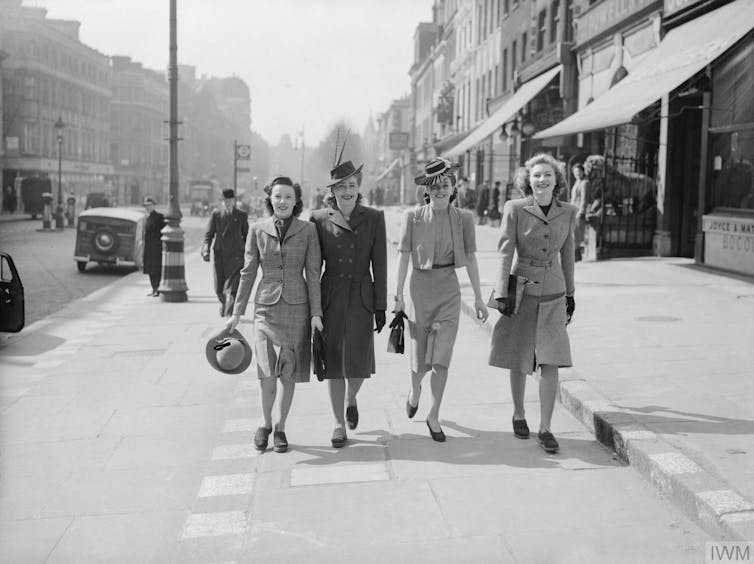
A change to shorter skirts and minimal detailing conserved precious resources during the second world war. © Imperial War Museum IWM (D 2937), CC BY-NC
So what can we do today?
In our current context, the most helpful thing we can do is to buy fewer new clothes and wear them for longer.
Australians buy a lot of clothes, about 56 items per year on average. That makes Australians the second highest textiles consumers in the world after the USA , and is 60% more than we bought even 15 years ago. The price of clothes has dropped significantly over the past couple of decades, and the number of clothes people have in their closets has grown.
If we begin to shift away from our slavish devotion to newness and novelty – following the dictates of fashion – to a mindset of value-led sufficiency, we can appreciate more fully the feel of lived-in, mended or altered clothes. There is a feeling of comfort in pulling on an old garment that is soft with age and repeated washing. There is joy in extending a garment’s life through creative mending, especially when that aligns with our values.
The Berlin-based Hot or Cool Institute suggests a wardrobe of 74 garments (including shoes but excluding undergarments) is typically sufficient for people who live in a two-season climate (in the tropics) and 85 pieces for those who live in a four-season climate, as most Australians do. If we buy ten to 12 new items a year, we can replace our entire wardrobe in about seven years.
Buying second-hand instead of new is even better because it doesn’t add to current production emissions. If we buy second-hand, it still doesn’t mean we should buy more than we need.
Choosing clothes to fit our values
To live authentic lives that are fulfilling and satisfying in deep and meaningful ways, we need to be true to our selves. In the case of clothing, we should evaluate our choices in relation to the values we hold. And if we do care about living sustainably, that means changing those choices we feel are no longer suited to the climate crisis.
Clothes need to reflect a person’s situation as well as their identity to “work” well. This may mean that what we wear changes as we make different buying decisions, just as people did in the second world war and as tree-changers do. We may start to look different, but that change signifies our values in action.
Best of all, clothing choices that align with keeping global warming to less than 1.5 degrees will have a long-term impact as significant as winning the war.







