


 EU Defence Build-Up Too Slow for 2030 Russia Readiness Goal
  Trump, Xi Focus on Trade and AI at White House Summit
  US Senate Rejects Iran War Powers Resolution in 50-49 Vote
  US Backs Musk in Fight Against EU’s €120 Million X Fine
  Kremlin Says No Decision Yet on Putin-Trump December Summit
  Russian Envoy Dmitriev Heads to US for Ukraine Talks
  Netanyahu Defends Israel at UN as Delegates Stage Walkout
  Abbas Reaffirms November 28 Palestinian Elections
  Netanyahu Takes Aim at Mamdani as Israel Election Nears
  Netanyahu’s Brief US Trip Highlights Strains With Trump
  Trump Asks Supreme Court to Restore Third-Country Deportations
  Mexico-US Trade Talks Delayed to October as Tariff Negotiations Continue
  Gaza Faces Evacuation Crisis as War-Damaged Buildings Risk Collapse
  Pezeshkian Says US Must Choose When Iran War Ends
  OpenAI Agent Breaches Australia Medicare Data Portal
  US, China Extend Trade Truce to Jan. 10 Ahead of Trump-Xi Summit
  Russian Missile and Drone Attack on Kyiv Kills Two, Damages Maternity Hospital


 Add as a preferred source on Google
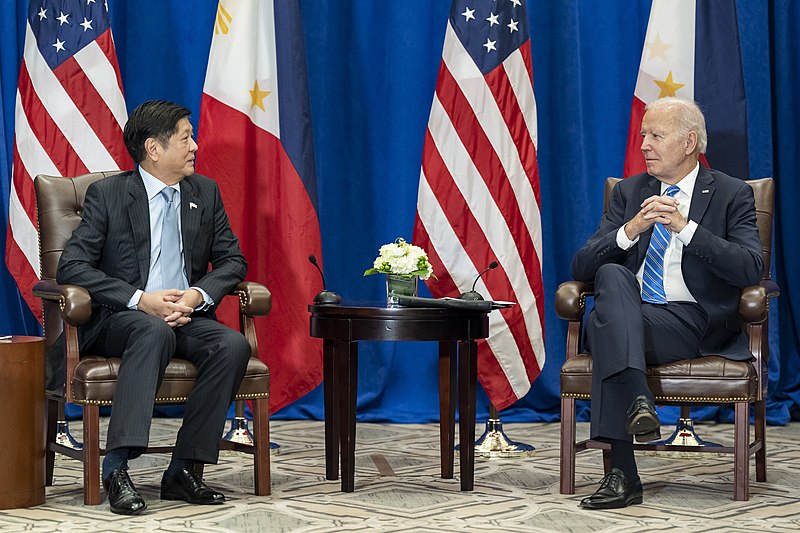
The United States has detailed its defense treaty commitments with its longtime ally, the Philippines, surrounding maritime security in the contested South China Sea. This also includes the issuance of new guidelines in case of a potential attack in the disputed waters.
The US released a six-page “bilateral defense guidelines,” which was agreed upon on Wednesday following a visit to Washington by Philippine President Ferdinand Marcos Jr. The guidelines followed a renewed call by Manila to update the Mutual Defense Treaty with the United States at a time of flared tensions with China on maritime matters. The guidelines were also the first time since the treaty was signed in 1951 following repeated Philippine protests against China’s increased activities in the contested waters.
China claims to have control over most of the South China Sea, citing the so-called nine-dash line. However, an international tribunal in 2016 ruled that Beijing’s claims have no basis under international law. China has since ignored the ruling and continued to assert its claims over the body of water, angering the neighboring countries that also have overlapping claims.
In the guidelines, the bilateral treaty commitments would be invoked should both sides be attacked in the South China Sea and if coast guard vessels were being targeted. The guidelines were also updated to include references to other tactics, including “grey zone” warfare, in which China is accused of using to continue asserting its claims of control over most of the waters.
“Recognizing that threats may arise in several domains – including land, sea, air, space, and cyberspace – and take the form of asymmetric, hybrid, and irregular warfare and grey-zone tactics, the guidelines chart a war forward to build interoperability in both conventional and non-conventional domains,” said the Pentagon.
During a summit between Biden and Marcos Jr. at the White House, Biden assured Marcos Jr. that the US commitment to the Philippines was “ironclad,” including in the disputed waters. Marcos Jr. said it was only “natural” for Manila to be close with the US, its sole treaty ally, at a time of “arguably the most complicated geopolitical situation in the world right now.”
Ahead of the meeting, as Biden welcomed Marcos Jr into the White House, the US leader said Washington would continue to support Manila’s “modernization” of the Philippine military.







