


 Trump and Merck KGaA Partner to Slash IVF Drug Costs and Expand Fertility Coverage
  Cogent Biosciences Soars 120% on Breakthrough Phase 3 Results for Bezuclastinib in GIST Treatment
  NASA's Artemis II Mission: First Crewed Lunar Journey Since Apollo
  Blue Origin’s New Glenn Achieves Breakthrough Success With First NASA Mission
  FDA Adds Fatal Risk Warning to J&J and Legend Biotech’s Carvykti Cancer Therapy
  Blue Origin New Glenn Rocket Explodes During Launch Pad Test, Delaying Space Ambitions
  Is space worth the cost? Accounting experts say its value can’t be found in spreadsheets
  NASA Artemis II: First Crewed Moon Mission Since Apollo Takes Four Astronauts on 10-Day Lunar Journey
  Trump Administration Releases New UFO Files and Apollo Mission Records
  Neuralink Expands Brain Implant Trials with 12 Global Patients
  Tabletop particle accelerator could transform medicine and materials science
  Trump Signs Executive Order to Boost AI Research in Childhood Cancer


 Add as a preferred source on Google
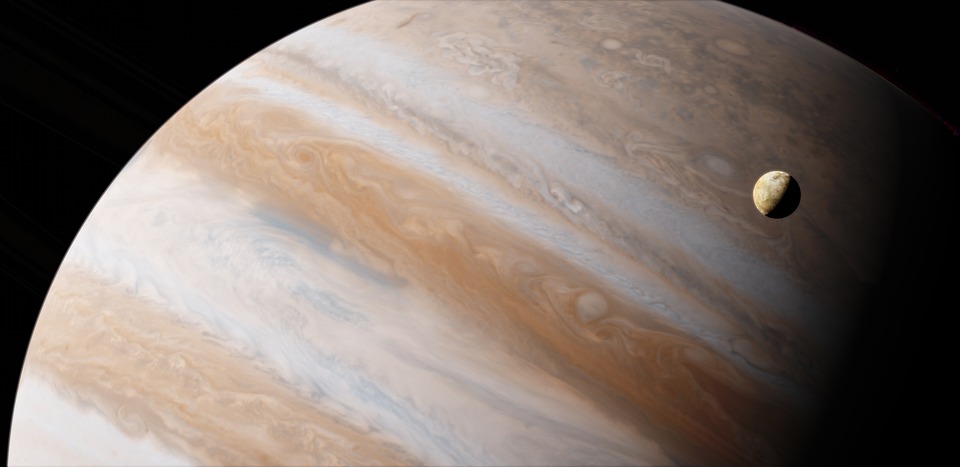
NASA is closely monitoring other planets in our solar system for signs of unusual activity in order to learn more about the universe. The Juno spacecraft was able to capture unusual weather within the gas giant as it managed to spot cyclones forming in its atmosphere.
The agency’s Juno spacecraft snapped an image of cyclones on Jupiter. The cyclones were spotted on the gas giant’s northern polar region, with wind speeds of nearly 400 miles per hour. The image released by NASA was in “extreme false color” and the different colors represented various features of the gas giant’s atmosphere.
“Cyclones at the north pole of Jupiter appear as swirls of striking colors in this extreme false color rendering of an image from NASA’s Juno mission. The huge persistent cyclone found at Jupiter’s north pole is visible at the center of the image, encircled by smaller cyclones that range in size from 2,500 to 2,900 miles or between 4,000 - 4,600 kilometers. Together, this pattern of storms covers an area that would dwarf the Earth,” said NASA about the photo.
Since it’s launch in 2011, the Juno spacecraft arrived at Jupiter in 2016 and started a polar orbit. The mission also happens to be the first mission that gave scientists a clear view of the polar regions of Jupiter.
Aside from the cyclones, the Juno spacecraft also snapped a lunar eclipse that occurred over Jupiter. The eclipse cast a black hole-like shadow over a part of the gas giant as one of its moons, Io, passed over. The image of the lunar eclipse was taken during the spacecraft’s 22nd flyby. Io happens to be one of the innermost and the third-largest of the planet’s four Galilean moons.
“Jupiter’s volcanically active moon Io casts its shadow on the planet in this dramatic image by NASA’s Juno spacecraft,” said the agency.
Because of the number of moons that Jupiter has, eclipses such as this one happen more frequently. Io is also the most volcanically active object in the solar system, according to NASA. Volcanic activity on Io could easily be seen because of its thin atmosphere when it spews material.







