


 Judge Dismisses Elon Musk’s Fraud Claims Against OpenAI, Trial to Proceed on Remaining Allegations
  Trump Faces Uphill Battle Seeking China’s Help on Iran Conflict
  Japan Considers Extra Budget Aid Amid Rising Fuel and Utility Costs
  Judge Orders Release of Family After Longest ICE Detention Under Trump Administration
  US Stock Futures Slip as Iran Tensions and Hot Inflation Data Pressure Wall Street
  TikTok Nears $400 Million Settlement With Trump Administration Over Child Privacy Lawsuit
  Asian Stocks Edge Higher as Tech Shares Rise Ahead of Trump-Xi Beijing Summit
  Asian Currencies Hold Steady as Strong U.S. Inflation Data Boosts Dollar
  Oil Prices Slip as Strait of Hormuz Disruptions and U.S. Inventory Data Keep Markets on Edge
  AI-Driven Inflation Raises U.S. Consumer Prices, Goldman Sachs Says
  Goldman Sachs Delays Fed Rate Cut Forecast to 2026 Amid Rising Inflation Concerns



The National Disability Insurance Scheme (NDIS) was created to boost the economic and social participation of Australians living with a disability. To this end, the scheme puts choice and control in the hands of people living with a disability.
An NDIS participant intending to find a job, for example, may choose support services from different developmental educators, as well as disability support workers, teachers or social workers – all with related yet distinct approaches to assisting individuals.
This flexibility means that policy outcomes – such as increased employability – depend on whether individuals make choices that are instrumental to finding and keeping jobs.
But we don’t actually know how NDIS participants weigh their personal goals and then make choices about achieving them through services, supports, therapies and interventions.
A participant might prefer the services of a more expensive developmental educator, for example, even if that means having out-of-pocket expenses.
We need to understand why such choices are being made. This might then result in a more effective funding allocation – with better policy outcomes.
There are many questions we need to answer. Do different disability types influence choices? Do the choices of NDIS consumers align with those of carers? How do choices differ depending on where the participant is located? What value do NDIS participants place on services, therapies or interventions that have a more robust evidence base?
And these are just the start of the questions.
The NDIS’s progressive welfare approach puts choice and control in the hands of consumers (or their nominated carers). Subject to an approved plan, a participant may select the assistance they believe will better help them achieve their goals, by choosing among competitors in the marketplace, or even available service providers with other specialisations.
Psychologists have long posited that personal goals (e.g., to be healthy, to save money) guide human choice. This perspective treats choice itself as an attempt to identify the outcome that best addresses one or more prioritised goals.
Despite theoretical support, little is known about what this means for the NDIS.
The need to examine these questions is becoming more urgent. According to published NDIS data, fully and partly self-managed plans have increased from 16.5% in prior quarters to 18% in September 2017.
Our survey
To explore some of the questions about NDIS choices, we have conducted an online survey with 30 current and potential NDIS consumers and 31 carers.
Our analysis has identified “to get a job or keep current employment” as one of the participants’ top ten goals.
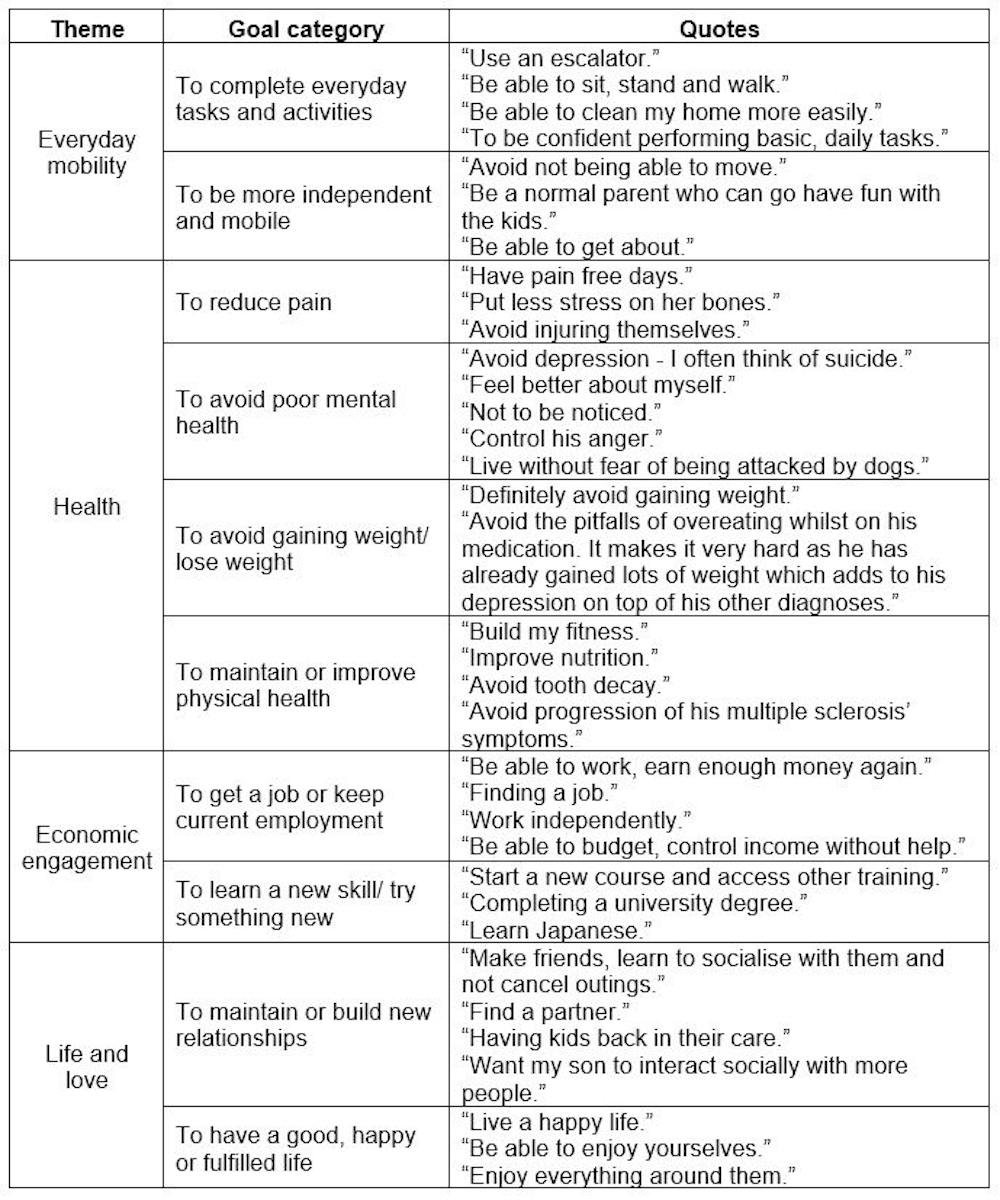
Survey findings.
Given the number of goals identified, it is important to understand whether this goal is a priority amongst other competing goals, and whether NDIS plan managers allocate their personalised funds to achieve it (for example, in areas where job supply is low or when faced with cognitive restrictions).
Moreover, when asked about which support services were required, carers in our sample were almost three times more likely to report home assistance (e.g., cleaning the house), whereas consumers reported work support (e.g., skills training) about twice as much as carers.
Whose plan is it exactly?
Understanding individual choices
The different responses from carers and participants show the need to understand individual choices in developing policy.
For decades mainstream economics has embraced the contribution of psychological insights in developing policies more attuned to the “real world”. Identifying the goals of NDIS participants is an important first step in creating customised plans to cater for idiosyncratic needs.
However, success of the scheme will rely on the skills and knowledge of plan managers and intermediaries when aligning the gamut of disability support services to the personal goals pursued.
A larger, more ambitious study is taking off - the first large-scale study of participant choice in the NDIS (by the Institute for Choice, National Disability Services and Capital Markets Cooperative Research Centre). To our knowledge, it’s an international first in applying concepts, methods (like discrete choice experiments) and approaches from consumer behaviour to choice architecture in the context of public sector (disability) markets.
Only through understanding individual choices can we create a NDIS with the necessary mechanisms for Australians with a disability to fulfil their life potential and the full citizenship that is their right.
Gordon Duff, General Manager of National Disability Services, contributed to this article







