


 BSP Sees Philippine Inflation Easing, Keeps Policy Options Open
  Citadel Warns High Treasury Yields Pose Broader Market Risks
  BOJ Rate Hike Expectations Rise Ahead of September Meeting
  Singapore Central Bank’s Exchange Rate Policy Explained: Why MAS Uses the S$NEER Instead of Interest Rates
  Australia Inflation Cools as Core CPI Misses Forecasts, Easing RBA Rate Hike Pressure
  Fed Holds Interest Rates Steady as Kevin Warsh Says Rising Treasury Yields Tighten Financial Conditions


 Add as a preferred source on Google
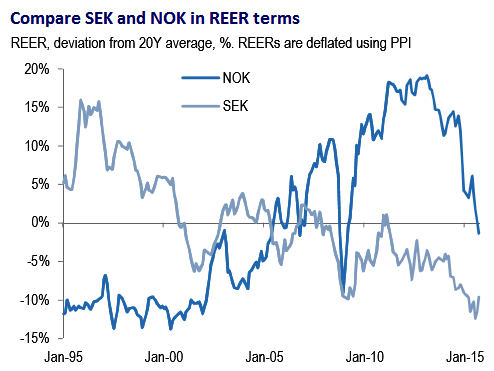
Scandinavian FX experienced the impetus of central banks resolutely pointing growth in Norway and inflation in Sweden. But the policy insertion was similar despite high Norwegian inflation and high Swedish growth.
The policy shackles should finally start to loosen for SEK next year. Growth will eliminate the output gap and core inflation should see 2% -the Riksbank's hyper-sensitivity to the exchange rate is not sustainable for a local economy that is cyclically stronger and structurally sounder than the Euro area.
EUR/SEK should eventually test the bottom of this year's 9.10-9.70 range in 2H on a late-cycle decoupling of ECB and Riksbank policy. There are limits to the Riksbank's policy of shadowing the ECB given macro divergence, as there were for the SNB.
FX weakness serves the Norges Bank's purpose in facilitating longer-term economic re-balancing irrespective of the CPI consequences. The Riksbank marginally out-did the Norges Bank (35bp of rate cuts and 5% of GDP in QE versus 50bp from the Norges Bank's) yet NOK was the harder hit, falling another 13% versus USD, 3% versus SEK and 1.5% versus EUR. NOK has now lost 36% of its value vs USD since 2013. SEK has shed 25%.
The worst real rates in G10 are a dead-weight on NOK. EUR/NOK unchanged end-2016. Expect interim upward pressure, but the peak is lowered to 9.50. End 2016 Forecasts being EUR/SEK 9.05, EUR/NOK 9.20, NOK/SEK 0.98.

- News

- Economy

- Central Banks
- Investing
- Research
- Roundups
- Digital Currency
- Insights
- Technical Analysis
- Technology
- Business
- Law
- Health
- Nature
- Fintech
- Science
- Topic
- Opinions
- ©Econometrics LLC . All Rights Reserved.
Scandis currency space sensing both warmer and chilly season – SEK seems cheaper than NOK
Wednesday, February 3, 2016 10:02 AM UTC
Editor's Picks



- Market Data
Most Popular




