


 Best Gold Stocks to Buy Now: AABB, GOLD, GDX
  US Debt Tops $40 Trillion as Global Borrowing Costs Surge
  Australia Inflation Cools as Core CPI Misses Forecasts, Easing RBA Rate Hike Pressure
  BOJ Rate Hike Expectations Rise Ahead of September Meeting
  Australia Unemployment Rate Hits 4.5% as Jobs Fall in July
  Singapore Central Bank’s Exchange Rate Policy Explained: Why MAS Uses the S$NEER Instead of Interest Rates


 Add as a preferred source on Google
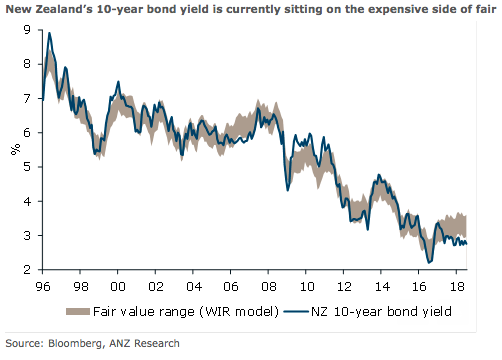
The Reserve Bank of New Zealand (RBNZ) may actually need to cut benchmark interest rates in order for NZGBs to further outperform their global peers from current levels, according to the latest report from ANZ Research.
New Zealand’s 10-year government bond yield has decoupled from the US, with the relative outlooks for monetary policy explaining most, but not all, of that divergence. It is a similar story when comparing New Zealand’s 10-year yield with a broader measure of the ‘world’ interest rate (estimated using principal components).
New Zealand bonds are starting to look a touch expensive. A solid local fiscal situation, improved external debt metrics and low global volatility perhaps help explain this outperformance (on top of domestic monetary policy of course), the report added.
The Government’s underlying fiscal balance is currently in surplus to the tune of 2 percent of GDP. This is the largest surplus since 2008 and the Government is projecting it to roughly hold around this level over the next four years.
"While we only have history back to 2009, we estimate that New Zealand’s sovereign CDS spread, at around 18bps, is sitting around the 5th percentile currently, implying the market sees very low default risk,” the report also commented.







