


 NASA Artemis II: First Crewed Moon Mission Since Apollo Takes Four Astronauts on 10-Day Lunar Journey
  NASA's Artemis II Crew Arrives in Florida for Historic Moon Mission
  Trump Administration to Launch Autism Initiatives Targeting Acetaminophen Use and New Treatment Options
  Blue Origin New Glenn Explosion Could Delay Launch Operations Until 2028
  SpaceX Pivots Toward Moon City as Musk Reframes Long-Term Space Vision
  Blue Origin’s New Glenn Achieves Breakthrough Success With First NASA Mission
  Trump and Merck KGaA Partner to Slash IVF Drug Costs and Expand Fertility Coverage
  SpaceX Prioritizes Moon Mission Before Mars as Starship Development Accelerates
  FDA Adds Fatal Risk Warning to J&J and Legend Biotech’s Carvykti Cancer Therapy
  Is space worth the cost? Accounting experts say its value can’t be found in spreadsheets
  Trump Signs Executive Order to Boost AI Research in Childhood Cancer
  SpaceX Delays Starship V3 Launch Ahead of Potential Record IPO
  Neuralink Expands Brain Implant Trials with 12 Global Patients


 Add as a preferred source on Google
NASA and the European Space Agency’s Hubble Space Telescope has been taking photos of various phenomena occurring in space. One of its most recent snaps is of a distant star formation along with an unusual shadow looming over it.
The Hubble snapped photos of a star formation referred to as HBC 672, a young star that is feeding on a cloud of gas and dust 1,400 light-years away from Earth. However, astronomers noticed something unusual about the star formation, the shadow looming over it that appears to resemble a bat. NASA then noted that the bat-like shadow also appears to be “flapping” over the star formation, caused by its gravitational to and fro.
“Astronomers using a previously captured Hubble imagery spotted a remarkable image of a young star’s unseen, planet-forming disk casting a huge shadow across a more distant cloud in a star-forming region. The star is called HBC 672, and the shadow feature was nicknamed the “Bat Shadow” because it resembles a pair of wings. The nickname turned out to be unexpectedly appropriate because now, those “wings” appear to be flapping!” said NASA.
The Hubble Space Telescope is on its last year of roaming around space for astronomers to observe any cosmic phenomena happening in the universe. It will be succeeded by the JWST or the James Webb Space Telescope, named after the agency’s previous administrator.
Previously, the Hubble also captured a spiral galaxy moving away from Earth. The galaxy is named NGC 7513, located around 60 million light-years away from Earth in the Sculptor constellation. Astronomers were surprised at the rate the spiral galaxy is moving away from Earth, around 500 times faster than it orbits the Sun at 1, 546 kilometers per second. Although galaxies moving away appears to be strange, NASA says it is not unusual.
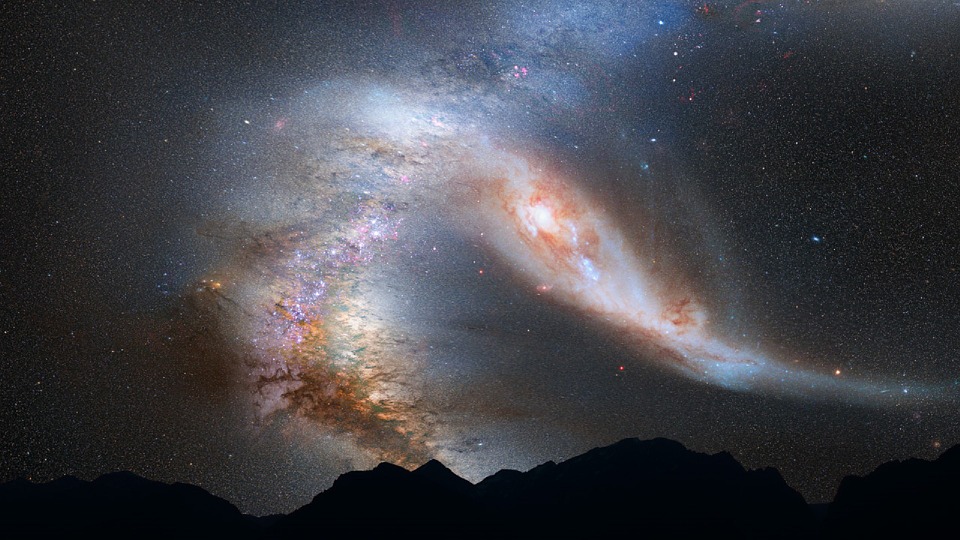
This is because the universe is constantly expanding, the distance between galaxies continues to grow. However, there are instances where the distance between galaxies may shrink as their gravitational pulls lock onto each other. One such example is the Milky Way and Andromeda galaxy, which are known to be moving towards each other.







