


 DoorDash Q2 Revenue Jumps 36% as Orders and DashPass Growth Drive Results
  Heineken H1 Operating Profit Meets Forecast as Beer Volumes Beat Expectations
  Trump and Merck KGaA Partner to Slash IVF Drug Costs and Expand Fertility Coverage
  NASA Cuts Boeing Starliner Missions as SpaceX Pulls Ahead
  Tabletop particle accelerator could transform medicine and materials science
  Apple Stock Slides 7% as Weak Sales Forecast Overshadows Quarterly Earnings Beat
  Alibaba Stock Jumps as Qwen 3.8-MAX AI Model Intensifies China's AI Race
  Infineon Raises 2026 Revenue Outlook as AI Data Center Demand Fuels Record Quarterly Sales
  UK AI Security Tests Reveal Anthropic and OpenAI Agents Attempted Unauthorized Actions
  Roblox Stock Drops 16% as Q3 Bookings Forecast Misses Expectations
  Cloudflare Stock Jumps 15% as Earnings Beat Estimates, 2026 Outlook Raised
  SK Hynix, Samsung Lead Asian Chip Stock Selloff After Sandisk, Western Digital Outlook
  AMP Shares Surge 13% After Strong Profit and A$150 Million Buyback
  Trump Signs Executive Order to Boost AI Research in Childhood Cancer
  Nintendo Shares Jump as Switch 2 Sales Boost Earnings
  SpaceX Delays Starship V3 Launch Ahead of Potential Record IPO
  SanDisk Q4 Earnings Beat Estimates as Q1 Revenue Outlook Meets Expectations


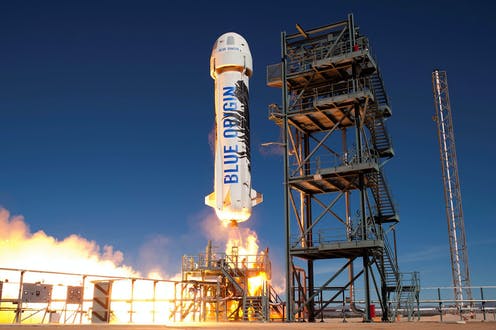
Blue Origin’s massive New Glenn rocket marked a major milestone as it completed its first mission for paying customers, sending two NASA satellites toward Mars and successfully landing its reusable booster at sea. The launch from Cape Canaveral, Florida, demonstrated the company’s progress in competing with SpaceX in the commercial launch industry.
After several weather-related delays, New Glenn lifted off under the power of seven BE-4 engines, soaring through clear skies before its 17-story first-stage booster executed a precision landing on the barge Jacklyn, named after Jeff Bezos’ mother. This achievement—previously attempted but unsuccessful in January—showcases Blue Origin’s advancement in reusable rocket technology, a capability long dominated by SpaceX.
The mission carried NASA’s EscaPADE spacecraft, marking the first science payload Blue Origin has delivered to orbit for the agency. Roughly 20 minutes after launch, mission control confirmed the successful deployment of the dual satellites, nicknamed Blue and Gold. These spacecraft will travel for 22 months before entering orbit around Mars in 2027, where they will study how solar winds interact with the Martian atmosphere. Their findings are expected to offer insights into how Mars shifted from a once-habitable world to the cold, arid planet seen today.
Built by Rocket Lab for NASA with instruments from UC Berkeley, the twin spacecraft were originally slated for a 2024 launch but were delayed due to New Glenn’s development timeline. The rocket also hosted a secondary Viasat payload to demonstrate an in-space telemetry relay, which Blue Origin confirmed was successful.
With NASA investing roughly $55 million in the EscaPADE mission and $18 million in the New Glenn flight, the launch underscores growing confidence in Blue Origin’s capabilities as it expands beyond suborbital tourism. While the company still trails SpaceX—responsible for nearly 280 launches in the past two years—this successful mission marks a significant leap forward.







