


 Blue Origin New Glenn Rocket Explodes During Launch Pad Test, Delaying Space Ambitions
  Neuralink Plans High-Volume Brain Implant Production and Fully Automated Surgery by 2026
  Eli Lilly’s Inluriyo Gains FDA Approval for Advanced Breast Cancer Treatment
  Jared Isaacman Confirmed as NASA Administrator, Becomes 15th Leader of U.S. Space Agency
  NASA Artemis II: First Crewed Moon Mission Since Apollo Takes Four Astronauts on 10-Day Lunar Journey
  Is space worth the cost? Accounting experts say its value can’t be found in spreadsheets
  Trump Administration Releases New UFO Files and Apollo Mission Records
  Blue Origin’s New Glenn Achieves Breakthrough Success With First NASA Mission
  SpaceX Pivots Toward Moon City as Musk Reframes Long-Term Space Vision
  FDA Pilot Program Eases Rules for Nicotine Pouch Makers
  Trump and Merck KGaA Partner to Slash IVF Drug Costs and Expand Fertility Coverage
  Cogent Biosciences Soars 120% on Breakthrough Phase 3 Results for Bezuclastinib in GIST Treatment
  Trump Signs Executive Order to Boost AI Research in Childhood Cancer


 Add as a preferred source on Google
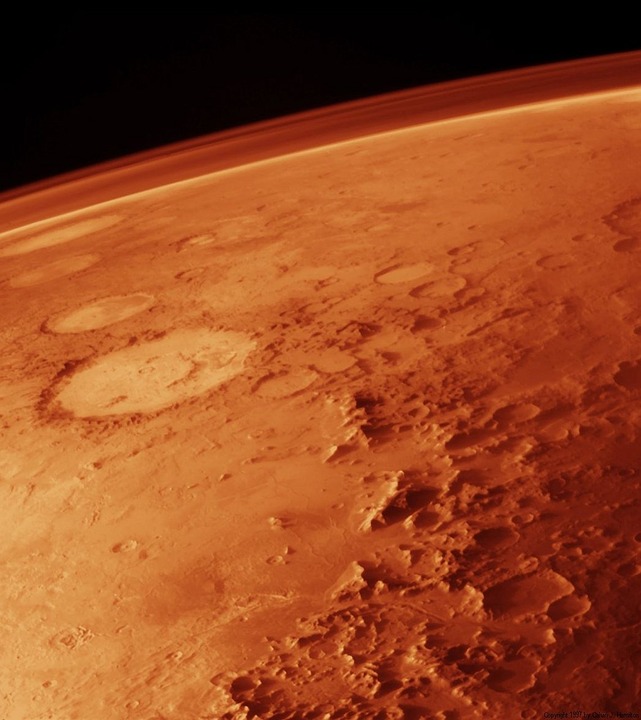
The future Mars mission will see astronauts setting foot on the Red Planet for the first time, with space agencies hoping to colonize Earth’s neighboring planet successfully. According to scientists, the best chance of colonizing Mars would be below its surface.
Express reports researchers from the University of Bologna found that the best way to colonize Mars in the upcoming missions successfully would be through the lava tubes found below its surface. Lava tubes are the third-most-common type of cave on earth, and these underground tunnels can run uninterrupted for kilometers at a time. They also noted that the conditions under and within these lava tunnels are perfect for shielding humans from cosmic radiation as well as Martian climates and asteroids, something thought to be unfeasible if humans were to colonize on the surface.
According to the study’s coordinator Francesco Sauro, “Lava tubes could provide stable shields from cosmic and solar radiation and micrometeorite impacts which are often happening on the surfaces of planetary bodies. Moreover, they have great potential for providing an environment in which temperatures do not vary from day-to-night time.”
Sauro also noted the upcoming Artemis mission by NASA, which will put the next humans on the lunar surface and will play a part in further lunar explorations. This mission also includes finding life on Mars, which is what the Perseverance Rover is out to do as it is on its way to Mars.
The researchers have also believed that the lava tubes found on the Red Planet may be much bigger than those found on Earth. The lava tubes on Mars may be 100 to 1000 times wider.
Meanwhile, scientists have now been able to explain how the key ingredients for life, such as carbon, are distributed in space. With the use of NASA’s Stratospheric Observatory for Infrared Astronomy or SOFIA, astronomers are now able to explain how carbon is distributed. Carbon is produced by a kind of star called a Mira star, through its core in a process called helium fusion. Over time, the carbon in these stars is ejected into space.
Mira stars are red giants in their latter-stage that have unusually powerful pulsations.







