


 Trump Signs Executive Order to Boost AI Research in Childhood Cancer
  Lost in space: MethaneSat failed just as NZ was to take over mission control – here’s what we need to know now
  NASA Astronauts Wilmore and Williams Recover After Boeing Starliner Delay
  NASA and Roscosmos Chiefs Meet in Florida to Discuss Moon and ISS Cooperation
  SpaceX Starship Test Flight Reaches New Heights but Ends in Setback
  Neuralink Expands Brain Implant Trials with 12 Global Patients
  Is space worth the cost? Accounting experts say its value can’t be found in spreadsheets
  FDA Adds Fatal Risk Warning to J&J and Legend Biotech’s Carvykti Cancer Therapy
  Tabletop particle accelerator could transform medicine and materials science
  Cogent Biosciences Soars 120% on Breakthrough Phase 3 Results for Bezuclastinib in GIST Treatment
  Neuren Pharmaceuticals Surges on U.S. Patent Win for Rare Disorder Drug
  Trump Administration to Launch Autism Initiatives Targeting Acetaminophen Use and New Treatment Options


The European Space Agency (ESA) successfully launched its CHEOPS satellite from Kourou, French Guiana in the early morning of Wednesday, December 18. The rocket carrying the satellite as its payload blasted off at 3:54 a.m. Eastern Time marking the start of ESA’s new space mission.
CHEOPS is an acronym of Characterizing Exoplanet Satellite, according to ScienceNews. As its name suggest, the satellite will be used to study planets outside of this solar system.
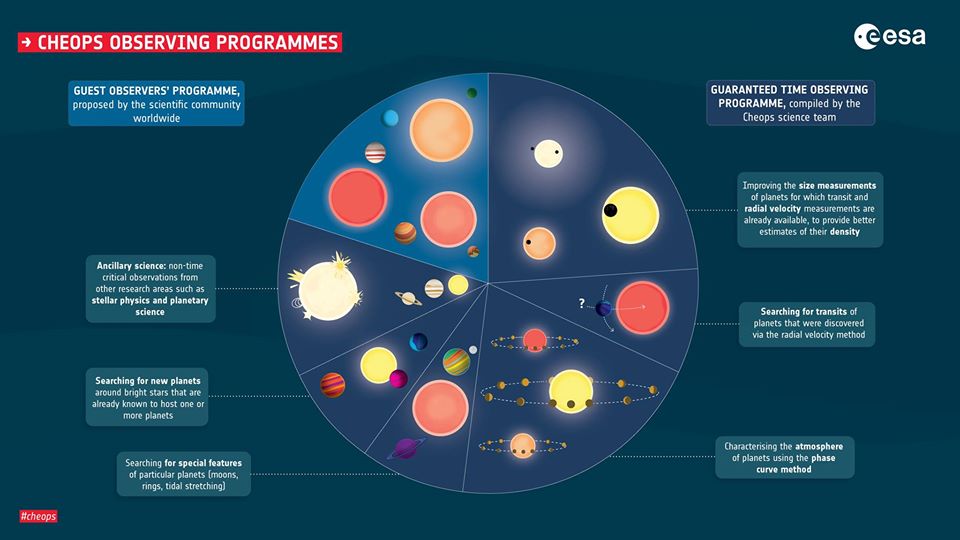
However, CHEOPS won’t be looking for new exoplanets to discover. Rather, its mission is to gather more data on already known planets orbiting other stars in the hopes that the data will help astrophysicists figure out how these heavenly bodies were created.
The satellite will be looking for exoplanetary transits while orbiting around earth. These events are seen as subtle dips in the intensity of the light coming from a particular star, which is caused when a planet crosses between the observer and the star it is orbiting.
There is a correlation between the drop in the intensity of the star’s brightness and the size of the planet. Bigger planets will naturally cause a bigger drop in the star’s brightness since it blocks more starlight compared to smaller ones. Researchers can then calculate the planet’s size based on how much the star darkened temporarily.
CHEOPS will orbit earth at an altitude of around 435 miles or 700 kilometers, according to The Guardian. The satellite will focus on exoplanets between super-Earth and Neptune in terms of size range.
“We want to go beyond statistics and study them in detail,” mission chief David Ehrenreich said prior to the launch of the satellite.
At present, around 4,000 exoplanets have been confirmed since 2019 Nobel physics prize-winner Didier Queloz discovered the first one, called 54 Pegasi b, 24 years ago. However, CHEOPS will be narrowing its subjects to just 500 of these planets.
ESA clarified that CHEOPS’s study won’t likely discover proof of extraterrestrial civilization in the stars but it could be the necessary first step in that direction. After all, its measurements could reveal clues about the planet’s atmosphere or surface.
“However, in order to understand the origin of life, we need to understand the geophysics of these planets,” ESA director of science Günther Hasinger said. “It’s as if we’re taking the first step on a big staircase.”













