


 Trump Signs Executive Order to Boost AI Research in Childhood Cancer
  Tabletop particle accelerator could transform medicine and materials science
  SpaceX’s Starship Completes 11th Test Flight, Paving Way for Moon and Mars Missions
  SpaceX Pivots Toward Moon City as Musk Reframes Long-Term Space Vision
  Neuralink Plans High-Volume Brain Implant Production and Fully Automated Surgery by 2026
  Trump Administration to Launch Autism Initiatives Targeting Acetaminophen Use and New Treatment Options
  China vs. NASA: The New Moon Race and What's at Stake by 2030
  SpaceX Delays Starship V3 Launch Ahead of Potential Record IPO
  Blue Origin New Glenn Rocket Explodes During Launch Pad Test, Delaying Space Ambitions
  Cogent Biosciences Soars 120% on Breakthrough Phase 3 Results for Bezuclastinib in GIST Treatment
  NASA Cuts Boeing Starliner Missions as SpaceX Pulls Ahead
  SpaceX Prioritizes Moon Mission Before Mars as Starship Development Accelerates
  Trump and Merck KGaA Partner to Slash IVF Drug Costs and Expand Fertility Coverage
  Is space worth the cost? Accounting experts say its value can’t be found in spreadsheets


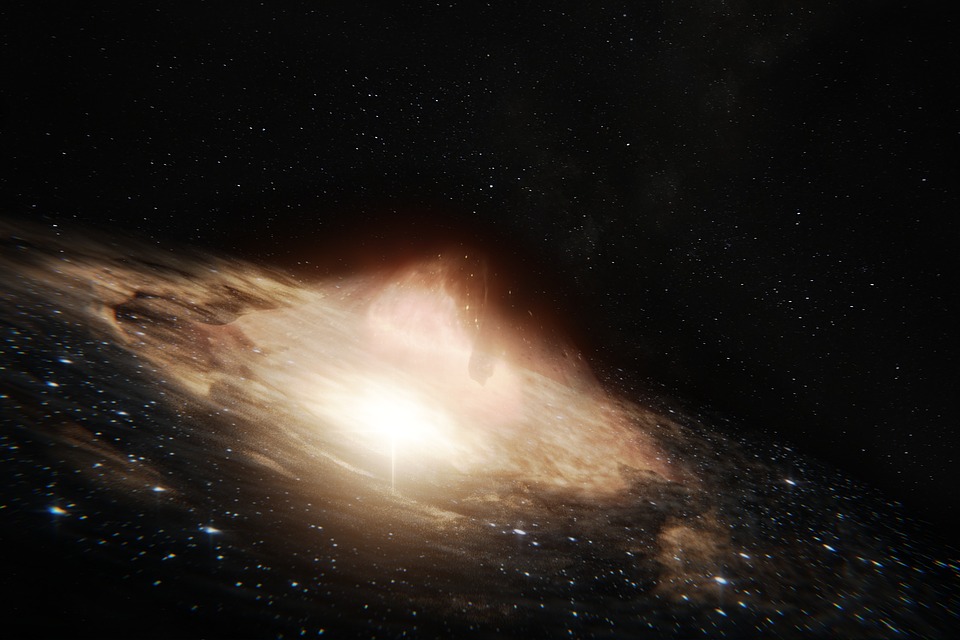
Black holes are one of the most mysterious yet most fascinating entities found in the universe. Recently, scientists were able to witness for the first time a black hole spewing out matter back into the cosmos.
Express reports that the astronomers at the Event Horizon Telescope or EHT were able to witness a black hole spewing particles back into the universe. The supermassive black hole is five billion light-years away from Earth and is in the middle of a quasar or the heart of the galaxy that has both a black hole and an accretion disk which is the gas and dust that surround the black hole that produces a huge amount of energy.
The powerful gravitational force of the accretion disks results in huge amounts of energy. Some materials get sucked into the black hole while others get spewed back into space. The materials are ejected at a rate of 99.5 percent the speed of light.
The astronomers at EHT were able to conduct a study, compiling images from the EHT to put together a video showing the activity of this particular supermassive black hole.
Lead researcher at MPIfR and the study’s lead author Jae young Kim was both puzzled and enthusiastic about this discovery. “We knew that every time you open a new window to the Universe you could find something new. Here, where we expected to find the region where the jet forms by going to the sharpest image possible, we find a kind of perpendicular structure,” shared Dr. Kim, regarding the process that led to capturing the activity.
Previously, astronomers have also discovered that the black hole that sits in the middle of the Milky Way galaxy is becoming active. The scientists found that between 2014 and 2017, the black hole that is 26,000 light-years away from Earth, spewed more X-ray flares than usual.
As to what caused the black hole to spew more flares than usual has yet to be determined. It may be due to the accretion disks or it may be because of the asteroids and other celestial objects passing by that would have caused the increase in X-ray flares.







