


 US Conducts Non-Nuclear Explosion Test to Boost Nuclear Detection
  Brazil Presidential Debate Canceled as Lula, Bolsonaro Skip Event
  New Zealand Election Raises Policy Uncertainty for Investors
  Marco Rubio to Visit Iceland, Greece and Portugal
  Netanyahu Says Israel May Join Flydubai Crash Attempt Probe
  Trump Says He Raised Political Prisoners With Xi
  Russia Warns NATO of Nuclear Response Over Kaliningrad
  Wicker Urges US to Uphold Taiwan Security Commitments
  Lula Leads Flavio Bolsonaro 48%-45% in Datafolha Poll
  US Waives $320M Egypt Military Aid Conditions After Iran War Role
  US Officials See China Taiwan Invasion Before 2028 as Less Likely
  Ukraine Deploys FP-7 Ballistic Missile in Combat for First Time
  California Leads Lawsuit Over Trump’s $810 Million Funding Cuts
  South Korea Warns Ukraine Over North Korean POW Dispute
  Trump Demands Powell Resign Over Fed Renovation Cost Overruns
  Pentagon Launches Autonomous Warfare Command
  Israel Tightens Pilot Security After Flydubai Incident


 Add as a preferred source on Google
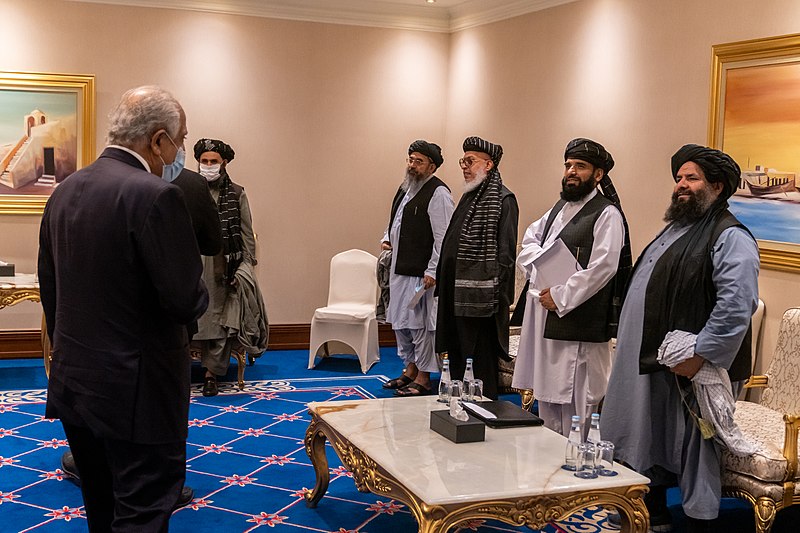
Since taking over Afghanistan in August of 2021, the Taliban has enacted restrictions mostly against women and girls. Members of the insurgent group recently tried to crack down on a protest for women’s rights by spraying demonstrators with pepper spray.
The Guardian reports that the Taliban forces sprayed pepper spray on a group of women who were protesting for women’s rights and education in the capital of Kabul. Around 20 women gathered in front of Kabul University over the weekend, demanding “equality and justice” with banners that also said “women’s rights, human rights.” Members of the insurgent group later broke up the protests as they arrived in several vehicles.
“When we were near Kabul University three Taliban vehicles came, and fighters from one of the vehicles used pepper spray on us,” recalled one woman to AFP. “My right eye started to burn. I told one of them, ‘Shame on you,’ and he pointed his gun at me.”
Two other demonstrators recalled that one of the women had to be brought to the hospital following an allergic reaction to the pepper spray aimed at them. A correspondent for AFP also saw one Taliban member confiscate the mobile phone of a man who was filming the protests.
The Taliban has banned unauthorized protests and has used force to intervene in demonstrations demanding equal rights for women and girls. Taliban authorities have also barred female public sector employees from returning to work and many secondary schools in Afghanistan have not been opened for girls as well as public universities remaining closed. The insurgent group has also banned long-distance trips for women unless accompanied by a close male relative.
In other related news, western Afghanistan was recently hit by an earthquake, leaving at least 26 people who died when their homes collapsed on them in the Qadis district in the western province of Badghis. The US Geological Survey said that the earthquake had a magnitude of 5.3 on the scale. Aside from 26 fatalities, four more people were injured from the calamity.
Badghis province spokesman Baz Mohammad Sarwary said that the number of casualties may increase, noting that the province is mountainous and is one of the most poverty-stricken regions in Afghanistan.







