


 Urban studies: Doing research when every city is different
  BOJ Rate Hike Expectations Rise Ahead of September Meeting
  Bank of America Posts Strong Q4 2024 Results, Shares Rise
  Moldova Criticizes Russia Amid Transdniestria Energy Crisis
  US Futures Rise as Investors Eye Earnings, Inflation Data, and Wildfire Impacts
  Gold Prices Slide as Rate Cut Prospects Diminish; Copper Gains on China Stimulus Hopes
  Eurozone Bond Yields Fall as Oil Slump Eases Inflation Fears Ahead of Central Bank Meetings
  Global Markets React to Strong U.S. Jobs Data and Rising Yields
  Chile Central Bank Holds Interest Rate at 4.5% as Inflation and Global Risks Persist
  Geopolitical Shocks That Could Reshape Financial Markets in 2025
  UBS Projects Mixed Market Outlook for 2025 Amid Trump Policy Uncertainty
  Australia Inflation Cools as Core CPI Misses Forecasts, Easing RBA Rate Hike Pressure


 Add as a preferred source on Google
The Antipodean pair now wants to retest the 1.0800 area, which looks vulnerable to giving way to 1.0750.
We expect NZD to fall through this year, reaching 0.63 at year-end. The support to growth from migration will fade, while the RBNZ – at the very least – is likely to hold rates steady as inflation normalizes, pushing real rates materially lower.
The economy is also now subject to credit tightening through numerous channels: macro-prudential constraints, regulatory initiatives, widening mortgage rate spreads, and banks’ discretionary tightening of credit criteria to businesses.
We now expect the RBNZ to be on hold this year, but there is a clear downside risk to the OCR over the course of the year.
On the flip side, a steady hand from the Fed in June plus an optimistic RBA should limit downside on AUDUSD during the next few months. Further out, though, the underlying AUD trend should be gently lower, as growing bulk commodity supply gradually cools the 2016 price surge. Iron ore should be back under $80/tonne by June, with further (modest) declines likely in H2 2017.
AUDNZD in medium term perspectives: Higher to 1.10+ but for now, slightly weaker. The cross remains well below fair value estimates implied by interest rates, commodity prices, and risk sentiment, although is closing the gap.
Hedging Framework:
3-Way Options straddle versus OTM Call
Spread ratio: (Long 1: Long 1: Short 1)
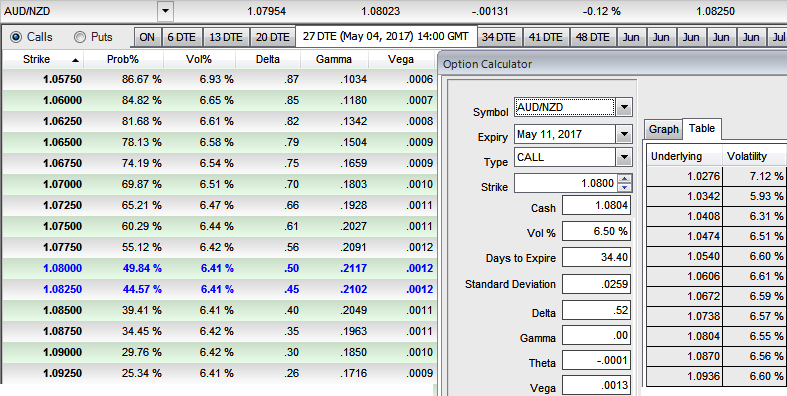
The execution: Initiate long in AUDNZD 3M at the money vega put, long 3M at the money vega call and simultaneously, Short theta in 1m (1%) out of the money call with positive theta or closer to zero.Theta is positive; time decay is bad for a buyer, but good for an option writer.
Rationale: As you could observe the higher probability of underlying spot is on OTM put strikes and their corresponding vega of long leg (buy) options position is reasonably healthier on either side and it implies that if IV increases or decreases by 1%, the option’s premium would have an impact in increase or decrease proportionately. And IVs of 1m tenor is on lower levels, good news for option writers.
Hence, we encourage vega longs and short thetas in the non-directional trending pair but slightly favors bearish strategy as the vega signifies the sensitivity of an option’s value owing to a shift in volatility. It is usually expressed as the change in premium value per 1% change in implied volatility.







