


 Saudi Arabia Seeks Military Support as Houthi Attacks Escalate
  Netanyahu Defends Israel at UN as Delegates Stage Walkout
  Pezeshkian Says US Must Choose When Iran War Ends
  NATO Boosts Intelligence Sharing Amid Russia Hybrid Threats
  Abbas Reaffirms November 28 Palestinian Elections
  EU Agrees €6.6 Billion Military Aid Funding for Ukraine
  US Backs Musk in Fight Against EU’s €120 Million X Fine
  Colombia Extradites FARC Dissident Leader ‘Spider’ to US
  Trump, Xi Visit US National Archives After White House Summit
  What ‘Taiwan Independence’ Means as Xi Presses Trump on US Policy
  Saudi Arabia, Turkey and Pakistan Plan Urgent Defence Talks Over Houthi Attacks
  France Defends Netanyahu Airspace Clearance Despite ICC Warrant
  Xi Calls for Deeper U.S.-China AI Cooperation in Trump Talks
  Trump, Xi Focus on Trade and AI at White House Summit
  Trump Warns China Against Supporting Iran in Xi Talks
  US Supreme Court Revives Trump Administration Voter Citizenship Database
  Netanyahu’s Brief US Trip Highlights Strains With Trump


 Add as a preferred source on Google
The United States has reaffirmed its commitment to defend the Philippines following a fresh clash between Chinese and Filipino vessels in the disputed South China Sea. The U.S. State Department on Monday strongly condemned Beijing’s “ramming and water cannoning” of a Philippine vessel near Sandy Cay in the Spratly Islands, a region that has become a flashpoint in regional maritime disputes.
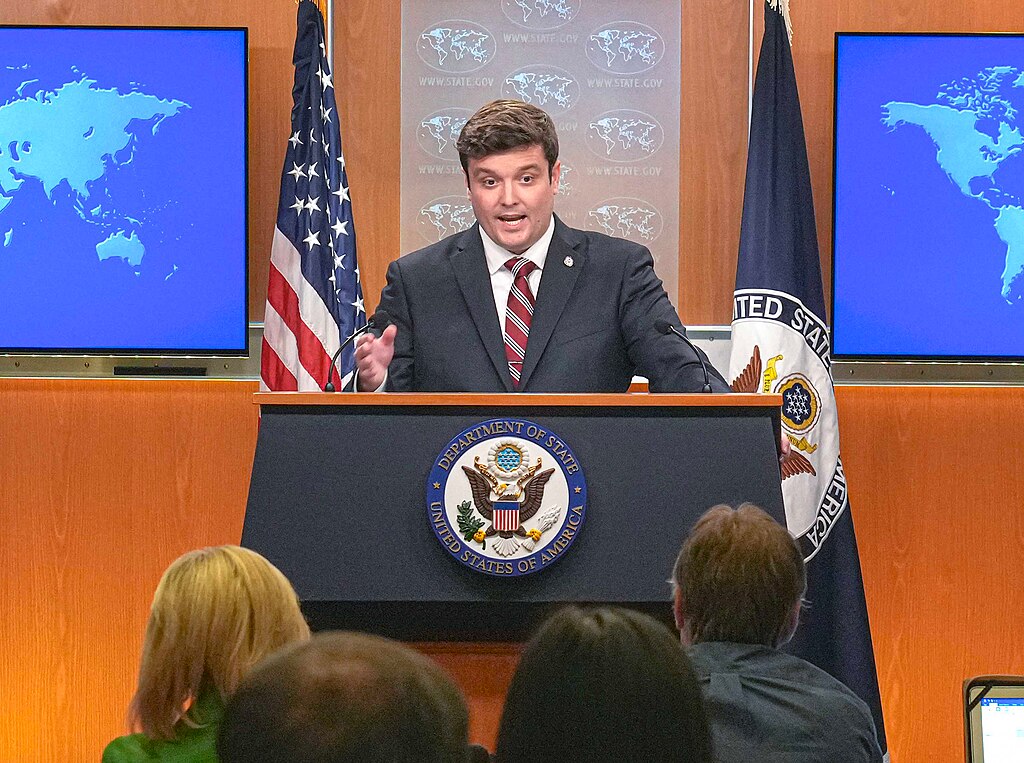
State Department spokesperson Tommy Pigott emphasized that Washington “stands with its ally” as China’s actions continue to “undermine regional stability.” He reiterated that Article IV of the 1951 U.S.-Philippines Mutual Defense Treaty extends to “armed attacks on Philippine armed forces, public vessels, or aircraft—including those of its Coast Guard—anywhere in the South China Sea.”
The confrontation occurred after China’s Foreign Ministry urged Manila to stop what it described as “violations and provocations,” defending its operations as measures to “safeguard territorial sovereignty and maritime rights.” The Philippines, however, accused China of escalating tensions through aggressive tactics.
The South China Sea remains one of the world’s most critical trade routes, facilitating over $3 trillion in annual commerce. Despite international rulings rejecting China’s expansive claims, Beijing continues to assert control over most of the waterway, putting it at odds with several Southeast Asian nations.
The U.S. State Department reiterated that China’s “sweeping territorial and maritime claims” violate international law and commitments to peaceful dispute resolution. American officials have increasingly called for tangible steps to deter Chinese aggression. Last year, senior U.S. senators urged the Pentagon and State Department to develop concrete support measures for the Philippines, arguing that limiting the U.S. response to verbal assurances weakens the credibility of its defense commitments.
As tensions rise, Washington’s latest statement underscores its intent to maintain a strong military and diplomatic presence in the Indo-Pacific to ensure freedom of navigation and uphold international law.







