


 SpaceX Delays Starship V3 Launch Ahead of Potential Record IPO
  Trump and Merck KGaA Partner to Slash IVF Drug Costs and Expand Fertility Coverage
  SpaceX’s Starship Completes 11th Test Flight, Paving Way for Moon and Mars Missions
  Blue Origin New Glenn Explosion Could Delay Launch Operations Until 2028
  NASA's Artemis II Mission: First Crewed Lunar Journey Since Apollo
  Tabletop particle accelerator could transform medicine and materials science
  Trump Administration Releases New UFO Files and Apollo Mission Records
  Blue Origin’s New Glenn Achieves Breakthrough Success With First NASA Mission
  FDA Adds Fatal Risk Warning to J&J and Legend Biotech’s Carvykti Cancer Therapy
  Neuralink Plans High-Volume Brain Implant Production and Fully Automated Surgery by 2026
  Cogent Biosciences Soars 120% on Breakthrough Phase 3 Results for Bezuclastinib in GIST Treatment


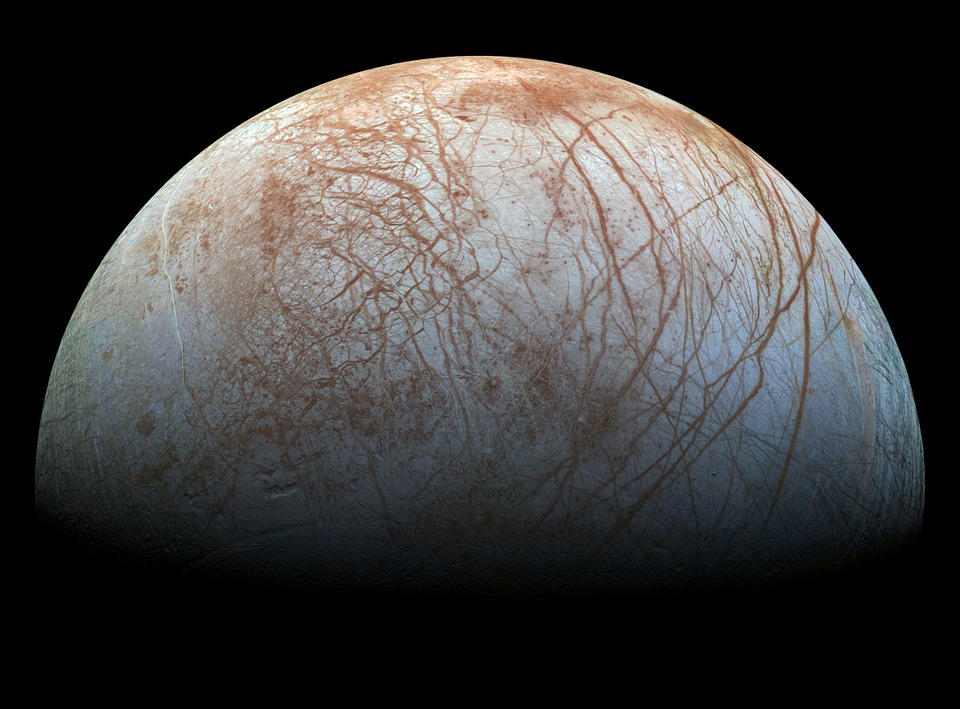
NASA has set its sights on one of Jupiter’s moons, Europa, alongside the moon and Mars. The agency’s scientists found some unusual red lines on the icy moon, which could suggest that life may be able to exist on the gas giant’s moon.
Express reports that in the program titled NASA’s Unexplained Files, the agency was looking into the mysterious red lines found on the surface of Europa. These lines appear to crisscross the moon, and some supposedly resemble the lines that indicate roads on Earth. According to scientist Brad Dalton back in 2001, “It has this strange reddish tint that looks kind of like rust, but it also looks a lot like some kind of slime.”
Dalton added that after conducting an infrared test, the features that may have been spotted on Europa could suggest that life is present on this moon. Dr. Neill Reid, an astronomer for the Hubble Space Telescope, however, theorized that the red streaks could mean the presence of certain chemicals or elements, most likely sulfur, which would explain why the streaks are red in color. “If you find water, then that’s the first step in saying that there could be life there,” said Dr Reid.
The possibility of life on Europa became even more likely by 2013 when the Hubble Space Telescope saw water flowing from its southern polar region. According to fellow NASA scientist Chris McKay, organisms known as extremophiles may also be present on Europa. These organisms are able to exist in environments that humans cannot.
Meanwhile, the agency’s scientists also found an unusual space object orbiting near the Sun. Footage of this sighting was recorded by NASA’s Solar Dynamics Observatory, showing a dark object as big as Jupiter, supposedly taking energy from the Sun. Due to its appearance, people who saw the footage on social media referred to it as the “Death Star” due to its resemblance to the space station seen in the Star Wars movies.
Knowing its nickname, scientists revealed that it is not impossible for such a thing to exist. They reasoned that the idea of being able to take energy from the Sun to fuel a spacecraft is doable as well as fantastic.







