


 US Dollar Rises for Fourth Week as Fed Rate Hike Bets Grow
  RBI Rate Hike Bets Surge as Inflation Rises
  UK Finance Minister Healey Calls for Fiscal Discipline Amid Global Risks
  Fed’s Hammack Says Bond Yield Surge Is Not Driven by Inflation Fears
  ECB May Stop Rate Hikes After December, Capital Economics Says
  Nasdaq Faces Pullback to 26,225 Despite Bullish Outlook, UBS Says
  Fed Unveils Stablecoin Rules Under GENIUS Act
  Trump Secures Russian Diesel Deal as US Fuel Prices Surge
  Cardano Hits Five-Year Transaction Record as ADA Price Falls
  Global Stocks Mixed as Oil Falls Ahead of US Earnings
  Philippines Current Account Deficit Seen at $19.1 Billion in 2026
  RBA Signals More Rate Hikes as Inflation Risks Rise
  Asian Stocks Plunge as AI Chip Selloff Hits South Korea and Japan
  RBI Uses $10 Billion Currency Swaps to Drain Excess Rupee Liquidity
  Visa Wins China Approval to Prepare Domestic Payments Expansion
  S&P 500 Rally Masks Losses for Over 40% of Stocks in 2026


 Add as a preferred source on Google
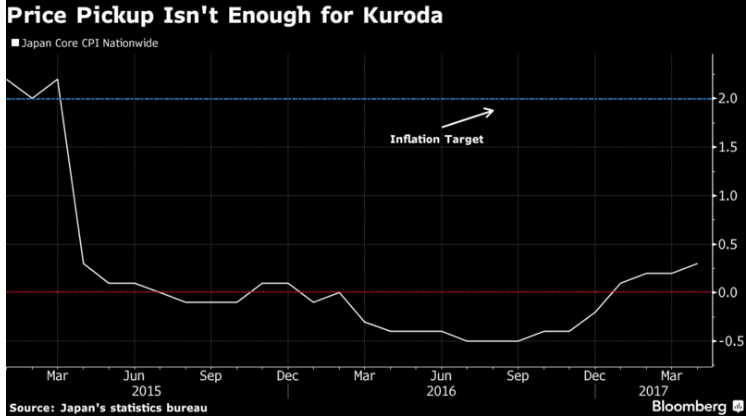
In Japan, data from the Internal Affairs Ministry showed on Friday that Japan’s core consumer inflation gauge rose for a fourth month in April, the longest run of gains since mid-2015, but remains far below the central bank's target. Both headline and core CPI inflation for April increased to 0.4 percent y/y and 0.3 percent y/y, respectively, but they remain well below the Bank of Japan’s (BoJ) target of 2.0 percent.
The Bank of Japan's preferred measure of core CPI (excluding fresh foods and energy) and its forecast measure of core CPI (excluding fresh foods) rose 0.1ppt to 0.0 percent Y/Y and 0.3 percent Y/Y respectively. The ‘core’ core rate, the measure consistent with core measures used in the other major economies, was still firmly in negative territory, unchanged on the month at 0.3 percent Y/Y, the lowest rate for almost four years just after the launch of QQE.
"We expect inflation to maintain a gradual upward trend over coming months associated with base effects of energy costs, with core CPI likely to rise close to 1%Y/Y by around September. But given the persistent weakness of underlying inflation, and not least due to the behaviour of wages which will likely serve to both limit cost pressures and restrain demand, we think that inflation will likely struggle to shift significantly higher than that," said Daiwa Capital Markets in a report.
Bank of Japan Governor Haruhiko Kuroda is pinning his hopes on rising energy costs, wage gains and the BOJ’s monetary stimulus program. Since wage growth remains weak, cost pressures are not strong enough to sustain stronger inflation. Former Federal Reserve Chairman Ben Bernanke said in Tokyo this week that the BOJ’s policy options are becoming scarce and more explicit cooperation with the government would be appropriate if inflation remains weak.
"Having committed to expanding the balance sheet until core CPI exceeds the 2% target in a stable manner, the Policy Board’s ultra-accommodative policy stance seems set to remain in place for a long time to come," adds Daiwa Capital Markets.
Meanwhile, Japan’s Nikkei 225 closed 0.64 percent lower on Friday at 19,686.84 points. At 1145 GMT, USD/JPY was trading at 111.00, down 0.74 percent on the day. At the same time, FxWirePro's Hourly Yen Strength Index remained highly bullish at 110 (a reading above +75 indicates a bullish trend, while that below -75 a bearish trend). For more details, visit http://www.fxwirepro.com/currencyindex.







