


 Fed Minutes Signal Another Rate Hike by Year-End
  FxWirePro: Daily Commodity Tracker - 21st March, 2022
  Visa Wins China Approval to Prepare Domestic Payments Expansion
  RBA Signals More Rate Hikes as Inflation Risks Rise
  Fed Unveils Stablecoin Rules Under GENIUS Act
  Yen in Focus as BOJ, Fed Rate Hikes Reshape Currency Markets


 Add as a preferred source on Google
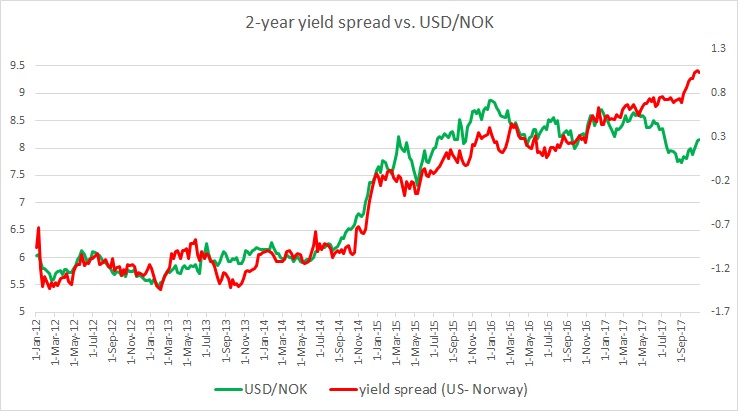
The chart above shows, how the relationship between USD/NOK and 2-year yield spread has unfolded since 2012.
- It can be seen that the pair and the yield spread between 2-year treasury and 2-year Danish government bond have enjoyed a very close relationship.
- The Norges Bank (NB) began reducing interest rates in the aftermath of the ‘Great Recession’ of 2008/09. The interest rates declined steadily from 575 basis points in 2008 to just 125 basis points in 2009.
- The lending rates were gradually increased to 200 basis points in 2010 as the impact of the ‘Great Recession’ was less severe and the price of oil recovered. It rose further to 225 basis points in 2011.
- However, the interest rates were reduced again in the aftermath of Eurozone debt crisis. Since the end 2011, DNB reduced rates from 225 basis points to just 152 basis points in 2012 and was further lowered in the aftermath of oil price crash in 2014 to just 50 basis points and it remained at the level.
- It can be seen from the chart as while DNB started reducing rates in 2011 and in 2015 and maintained dovish tone, and the US Federal reserve indicated and began to wind up its asset purchases, the 2-year yield spread widened in favor of the dollar by more than 200 basis points and the exchange rate declined from 5.5 per dollar to 8.9 per dollar.
- However, since the beginning of this year, there have been speculations in the market that the Norges Bank (DNB) would soon follow other central banks in the region, namely the Czech National Bank (CNB) that increased interest rates by 20 basis points. However, the speculation remains capped by falling inflation rate that declined to 1.5 percent in August and a lower oil price.
- In our review in August, we noted that despite lower oil price and falling inflation, a strong divergence is visible as the yield spread has widened this year by almost 18 basis points in favour of the dollar, while Danish Krone has strengthened by more than 600 pips. So, the exchange rate moved much faster than the spread, which is not an unnatural phenomenon. However, we noted that such divergence will not be sustainable in the medium term. Hence, we expect hawkish commentaries from DNB and warned that in absence of which the exchange rate could decline favouring the dollar. The spread was then at 71 basis points and the exchange rate at 7.9 per dollar.
- In our last review in October, we noted that the yield spread has widened by 22 basis points in favour of the dollar, while the NOK has weakened by 60 pips.
Though the exchange rate started responding to the spread. The divergence was still quite large. Since the last review, Yield spread narrowed by 10 basis points in favour of the dollar and the Norwegian Krone weakened by around 180 basis points, thus reducing the divergence.
With central banks changing their monetary policy outlooks, we highly recommend regular following of the yield spread.
FxWirePro launches Absolute Return Managed Program. For more details, visit http://www.fxwirepro.com/invest







