


 Trump’s Inflation Claims Clash With Voters’ Cost-of-Living Reality
  Trump Endorses Japan’s Sanae Takaichi Ahead of Crucial Election Amid Market and China Tensions
  Trump Signs “America First Arms Transfer Strategy” to Prioritize U.S. Weapons Sales
  Iran–U.S. Nuclear Talks in Oman Face Major Hurdles Amid Rising Regional Tensions
  U.S. to Begin Paying UN Dues as Financial Crisis Spurs Push for Reforms
  Pentagon Ends Military Education Programs With Harvard University
  TrumpRx Website Launches to Offer Discounted Prescription Drugs for Cash-Paying Americans
  Trump Backs Nexstar–Tegna Merger Amid Shifting U.S. Media Landscape
  US Pushes Ukraine-Russia Peace Talks Before Summer Amid Escalating Attacks
  Nighttime Shelling Causes Serious Damage in Russia’s Belgorod Region Near Ukraine Border
  Trump Allegedly Sought Airport, Penn Station Renaming in Exchange for Hudson River Tunnel Funding
  U.S. Announces Additional $6 Million in Humanitarian Aid to Cuba Amid Oil Sanctions and Fuel Shortages
  Netanyahu to Meet Trump in Washington as Iran Nuclear Talks Intensify
  New York Legalizes Medical Aid in Dying for Terminally Ill Patients
  Trump Lifts 25% Tariff on Indian Goods in Strategic U.S.–India Trade and Energy Deal
  Japan Election 2026: Sanae Takaichi Poised for Landslide Win Despite Record Snowfall


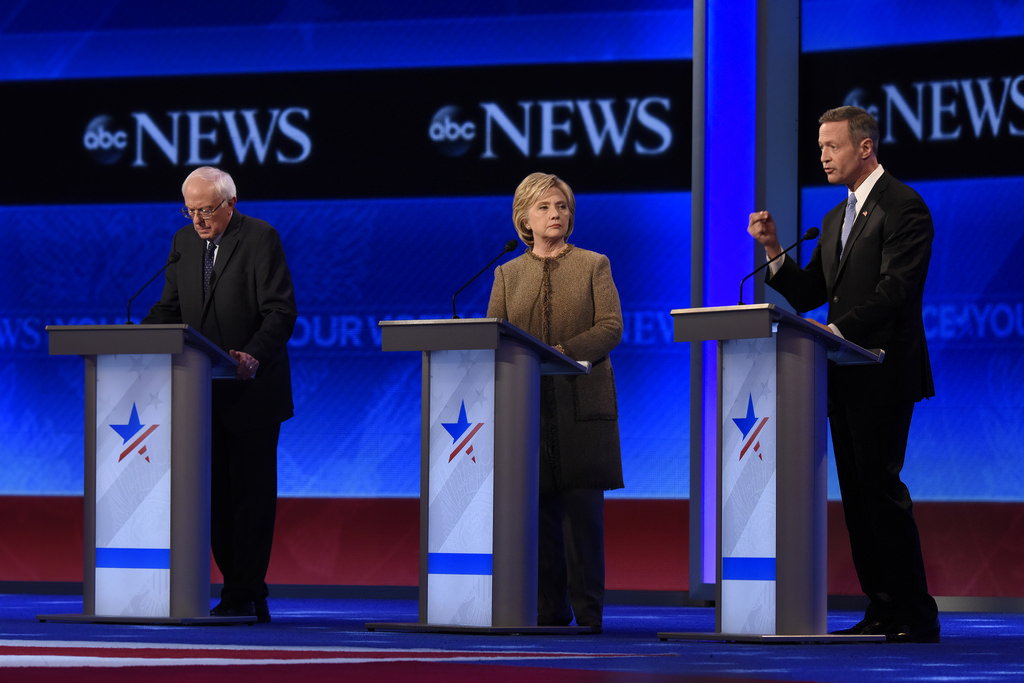
The three Democratic presidential candidates took the debate stage in New Hampshire Saturday night, less than two months before the first-in-the-nation primary there. Perhaps you missed the debate or the exchanges between candidates left you with questions. Below is a roundup of the key issues that were covered, along with links to relevant stories from The Conversation to add depth and perspective.
Saturday night’s debate was the second in a busy political week. The GOP candidates faced off over foreign policy issues during a prime-time debate in Las Vegas Tuesday which drew 18 million viewers. By contrast, the Democratic debate – tucked away on the last Saturday before Christmas – drew fewer than seven million.
Trump a presence
Donald Trump, who is ahead in New Hampshire in recent polls, was the only Republican candidate mentioned during the debate.
Clinton called him out for his “bluster” and “bigotry,” even saying ISIS recruiters were using video of Trump’s anti-Muslim rhetoric to gain supporters. (There’s no evidence for that, according to Politifact.) Martin O'Malley said American politics shouldn’t be dominated by a “billionaire with a big mouth.”
New Hampshire Governor Maggie Hassan, who was in the audience at St Anselm College, briefly took the spotlight. Hassan was the first democratic governor to call for a complete halt in the acceptance of Muslim immigrants into the US.
Clinton and O'Malley both broke with Hassan’s position, with Clinton remarking she didn’t want to turn into “a nation of fear.” In two well-read pieces on our website, scholars present evidence to support Clinton and O'Malley’s position. David Mednicoff of the University of Massachusetts Amherst argues that accepting more Syrian refugees could be good for national security. Sarah Lyons-Padilla of Stanford and Michele Gelfand of the University of Maryland say a warmer embrace of Muslims could stop homegrown terrorism.
ISIS, Assad and regime change
The candidates also discussed their strategies for fighting ISIS and the broader issues unsettling the Middle East.
Clinton struck an optimistic note, saying the US was “where it needs to be” on ISIS. But Sanders accused Clinton – who, like President Obama, backs the removal of Syria’s leader Bashar Assad – of not considering the consequences of regime change in Syria’s civil war. Sanders said:
I worry that Secretary Clinton is too much into regime change and too aggressive without knowing what the unintended consequences could be.
Sanders used Libya as a case in point. This article explores what’s happened in Libya since Muammar Gadhafi was overthown in 2011.
Taxes, Wall Street and the cost of college
Clinton vowed not to raise taxes for families earning under US$250,000, while Sanders focused on income inequality.
All three candidates distanced themselves from most of the Republican field by supporting a raise in the minimum wage. In a related article, an expert at MIT’s Sloan School of Business called for new government policies to deal with stagnating wages. The candidates are divided on just how much the minimum should increase – Sanders and O'Malley favor $15, with Clinton at $12.
Another professor – this one from host St Anselm College – asked the candidates about another financial issue affecting the middle class: student loan debt. Student loan debt has tripled in the past decade, but our expert says considering it a “crisis” is probably overblown.
Gun violence
A significant difference between Clinton and Sanders lies in their positions on gun control.
O'Malley slammed Sanders’s record of supporting a freeze on federal research on gun violence, but factcheck.org pointed out the vote took place 19 years ago.
Martin O'Malley, who served as mayor of Baltimore, attempted to tout his record on race relations and policing reform, but it was a hard sell since Baltimore is practically synonymous with the unrest that has rocked America’s cities in 2015. This article explains some of the root causes, including slums and lead poisoning.
What wasn’t said
Barely mentioned during the two-hour event? The heroin epidemic, Obama’s nuclear deal with Iran, and climate change. The final oversight was surprising given that the debate took place just a week after a historic summit where President Obama joined other leaders in vowing to cut emissions.
One thing what was discussed in some depth: Who will pick flowers and china in the White House if Hillary wins. (Answer: not Bill.)
The best one-liner of the night may have been Clinton’s Star Wars sign-off. “Thank you, goodnight, and may the force be with you!” she said – perhaps reminding political reporters of something they would have preferred to be doing on a Saturday night.
 This article was originally published on The Conversation. Read the original article.













