


 BOJ Hawk Signals Faster Interest Rate Hikes Amid Inflation Risks
  Oil Prices Rebound as Strait of Hormuz Tensions Return After Ship Attack Near Oman
  South Korea’s KOSPI Jumps Over 5% as Samsung, SK Hynix Rally on Micron Earnings Boost
  White House Seeks $87.6 Billion Emergency Funding for Iran War, Farmers, and Ebola Response
  US Dollar Slips After PCE Inflation Data Eases Fed Rate Hike Expectations
  Gold Falls Below $4,000 as Strong Dollar and Fed Rate Hike Expectations Weigh on Prices
  South Korea’s KOSPI Plunges as Apple Price Hikes and OpenAI IPO Delay Shake AI Chip Stocks
  Malaysia Central Bank Moves to Support Ringgit Amid Foreign Fund Outflows
  Japan Signals Preference for Low Interest Rates as BOJ Policy Debate Intensifies


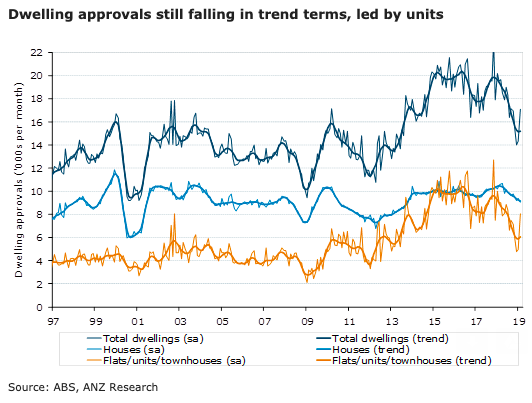
Australia’s building approvals increased sharply in February, building on the small lift in January. This suggests we may be past the peak period of falling building approvals after the sharp declines in November and December.
The country’s residential building approvals rose 19.1 percent m/m in February, following a 2.3 percent increase in January. The improvement was driven by a 62.4 percent m/m increase in unit approvals (from a 3.3 percent increase in January), while house approvals fell 3.7 percent m/m (from a 1.8 percent increase). The trend in approvals remains soft, though, down 21.7 percent y/y.
New South Wales saw another rise in approvals, rising 25 percent m/m in seasonally adjusted terms, led by a 70 percent increase in unit approvals, while detached house approvals fell 15 percent. Victoria experienced a sharp increase in seasonally adjusted approvals, up 37 percent m/m, driven by a massive increase in units (134 percent), while detached house were flat (0.6 percent).
Western Australia posted a decline, down 11 percent m/m (following a 28 percent increase in December). Total approvals in Queensland rose for the first time in several months, up 3 percent m/m seasonally adjusted. South Australia fell 2 percent m/m.
The value of non-residential approvals increased 2.1 percent m/m, following the 5.5 percent increase in January. In annual terms, however, non-residential approvals were 15.7 percent lower.
"Given data volatility, it is a little early to conclude that approvals have bottomed but these data are another sign that there is still life in the Australian economy," ANZ Research commented in its latest report.







