


 Adobe Names Anil Chakravarthy CEO as AI Push Accelerates
  Nvidia Eyes $2.5 Billion Investment in Thinking Machines Lab
  MongoDB Stock Sinks 14% as Atlas Growth Misses Expectations
  PayPal Shares Sink as $50 Billion Takeover Bid Collapses
  Texas Republicans Turn Against AI Data Centers as Election Backlash Grows
  OpenAI Nears Astra AI Model Launch With Safety Focus
  JPMorgan Sees ECB Raising Rates to 2.75% in December
  Lenovo Shares Fall After Dropbox Security Breach Exposes ID Vulnerability
  Apple’s Phil Schiller Steps Back as Leadership Shake-Up Accelerates
  SpaceX Turbine Push Unlikely to Threaten Howmet, Bernstein Says


 Add as a preferred source on Google


When disaster or tragedy strikes, people far away are touched and want to help – but really can’t do much. Often the first thing distant observers do is take to social media to send their thoughts, prayers, support and good wishes for survivors, rescue workers and others affected. And a lot of times, those online posts involve emoji – as well as hashtags in the poster’s own language, and other languages.
Our research analyzed emoji and their accompanying text to identify how people used emoji to express solidarity on Twitter during two crises, the November 13, 2015, terror attacks in Paris and the destruction wrought by Hurricane Irma in August and September 2017. The existing research on emoji use hasn’t looked at how people communicate support on social media. We were able to quickly see that rather than depictions of the person having an emotional reaction, most tweets expressing solidarity included non-face emoji.
Non-face emoji can help clarify readers’ perceptions of the message. As the Paris attacks unfolded, the most common support emoji were flags of different countries like Russia ????????, the U.K. ???????? and the U.S. ????????, alongside the French flag ????????. These, we know, were from people in other countries sending their thoughts to those affected in France. Other related emoji didn’t express solidarity, but conveyed what was happening: Tweets around the Paris attacks used ???? and ☎️ to indicate danger and information.
For the Hurricane Irma event, solidarity was expressed with the help of different kinds of hearts, like ❤️ and ????. A unique characteristic of solidarity during Hurricane Irma event expressed concern for the animals affected, like ????, ???? and ????. Flag emoji were not as prominent as during the Paris attacks.
Co-occurring emoji
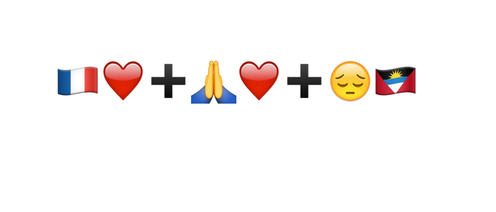
Often people use emoji paired together. During the Paris attacks, for instance, people sending love to France posted the ????????❤️ pair. During Hurricane Irma, people sending thoughts and love posted the ????❤️ emoji from afar. People in regions affected by the storm often posted the ???????? pair.
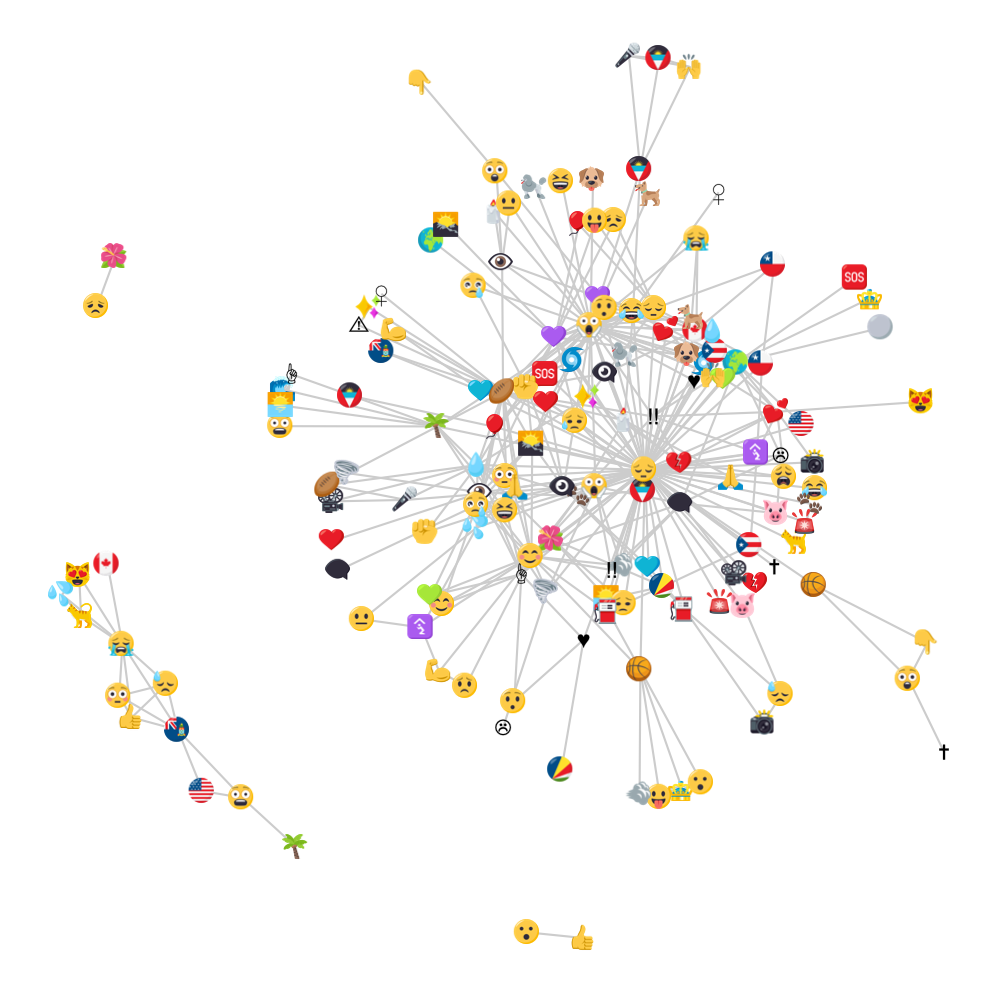
A network diagram shows how people from outside the affected regions used pairs of emoji to express emotions about Hurricane Irma. Santhanam et al., CC BY-ND
By contrast, during Hurricane Irma, the most commonly used emoji pairs in tweets from from outside the storm’s area included the sorrow emoji ???? with either the flag of Antigua and Barbuda ???????? or Cuba ????????.
As both events unfolded, tweets carried a steady stream of positive emoji, like ???? and ????, which continued into the days afterward. Negative emoji, like ???? and ????, on the other hand, peaked at key points – as Hurricane Irma moved closer to the U.S., and during the night of the Paris attacks – but disappeared almost completely afterward.
Documenting how people use emoji to communicate about large disasters offers a new window into human behavior, including how it evolves over time and across the world. In the future, we hope to explore emoji use in connection with collective social movements like #MeToo and #MarchForOurLives.







