


 China Warns US Arms Sales to Taiwan Could Disrupt Trump’s Planned Visit
  U.S. Lawmakers to Review Unredacted Jeffrey Epstein DOJ Files Starting Monday
  TrumpRx.gov Highlights GLP-1 Drug Discounts but Offers Limited Savings for Most Americans
  Anutin’s Bhumjaithai Party Wins Thai Election, Signals Shift Toward Political Stability
  India–U.S. Interim Trade Pact Cuts Auto Tariffs but Leaves Tesla Out
  Trump Allows Commercial Fishing in Protected New England Waters
  Bosnian Serb Presidential Rerun Confirms Victory for Dodik Ally Amid Allegations of Irregularities
  US Pushes Ukraine-Russia Peace Talks Before Summer Amid Escalating Attacks
  Jack Lang Resigns as Head of Arab World Institute Amid Epstein Controversy
  Trump Congratulates Japan’s First Female Prime Minister Sanae Takaichi After Historic Election Victory
  Netanyahu to Meet Trump in Washington as Iran Nuclear Talks Intensify
  Israel Approves West Bank Measures Expanding Settler Land Access
  Trump Backs Nexstar–Tegna Merger Amid Shifting U.S. Media Landscape
  New York Legalizes Medical Aid in Dying for Terminally Ill Patients
  U.S.-India Trade Framework Signals Major Shift in Tariffs, Energy, and Supply Chains
  Trump’s Inflation Claims Clash With Voters’ Cost-of-Living Reality
  Japan’s Prime Minister Sanae Takaichi Secures Historic Election Win, Shaking Markets and Regional Politics


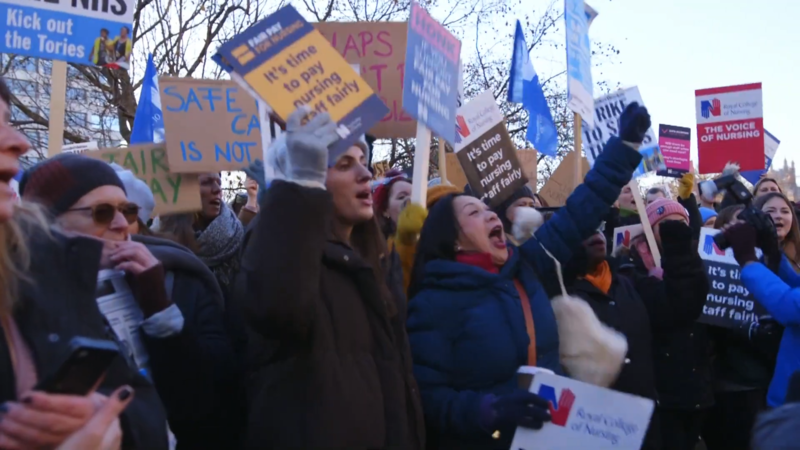
Nearly half a million teachers and civil servants in the United Kingdom took what is the biggest industrial action over pay this week. This comes as unions have threatened more disruptive strikes until the government agrees to their pay demands.
On Wednesday, nearly 500,000 teachers, train drivers, and civil servants in the UK staged a mass walkout over pay in what is the biggest industrial action taken in recent months. The walkouts resulted in schools getting shut down, halting most rail services, and forcing the military to be placed on standby to assist in border checks on a day referred to as “Walkout Wednesday.”
The mass walkout also comes as trade unions have threatened to take more disruptive action unless the government agrees to their demands. Unions say as many as 300,000 teachers participated in the walkout, making them the biggest group involved in what is a wider action taken by 500,000 people, the highest number since 2011.
The Conservative government under Prime Minister Rishi Sunak has taken a more hardline stance against the unions, saying that giving in to the demands would only worsen the country’s inflation problem. Sunak has also condemned the strikes.
“I am clear that our children’s education is precious and they deserve to be in school today being taught,” said Sunak.
The PCS union, which represents around 100,000 civil servants from over 12 government departments that are going on strike, said that further coordinated strikes may be done unless the government tries to resolve the issue.
Meanwhile, the country’s pharmaceutical trade body called for the government to scrap the plans to raise the repayment rates for drugmakers in order to prevent potential setbacks. Drugmakers under the UK’s voluntary scheme agreement are required to pay a part of their drug revenue to the government. The Health and Social Care department plans on raising the repayment rate to 27.5 percent from 24.5 percent.
The government’s plans to raise repayment rates will likely send the “worst possible signal” to global investors and boardrooms, according to the Association of the British Pharmaceutical Industry.
“Hiking these clawbacks to such uncompetitive levels risks undermining the UK’s offer to global life sciences companies,” said ABPI chief executive Richard Torbett in a statement.













