


 U.S. Lawmakers to Review Unredacted Jeffrey Epstein DOJ Files Starting Monday
  China Warns US Arms Sales to Taiwan Could Disrupt Trump’s Planned Visit
  US Pushes Ukraine-Russia Peace Talks Before Summer Amid Escalating Attacks
  Ghislaine Maxwell to Invoke Fifth Amendment at House Oversight Committee Deposition
  Japan’s Prime Minister Sanae Takaichi Secures Historic Election Win, Shaking Markets and Regional Politics
  Nicaragua Ends Visa-Free Entry for Cubans, Disrupting Key Migration Route to the U.S.
  Trump Backs Nexstar–Tegna Merger Amid Shifting U.S. Media Landscape
  Antonio José Seguro Poised for Landslide Win in Portugal Presidential Runoff
  Jack Lang Resigns as Head of Arab World Institute Amid Epstein Controversy
  Federal Judge Restores Funding for Gateway Rail Tunnel Project
  Ohio Man Indicted for Alleged Threat Against Vice President JD Vance, Faces Additional Federal Charges
  Taiwan Says Moving 40% of Semiconductor Production to the U.S. Is Impossible
  Trump Lifts 25% Tariff on Indian Goods in Strategic U.S.–India Trade and Energy Deal
  India–U.S. Interim Trade Pact Cuts Auto Tariffs but Leaves Tesla Out
  New York Legalizes Medical Aid in Dying for Terminally Ill Patients
  Netanyahu to Meet Trump in Washington as Iran Nuclear Talks Intensify


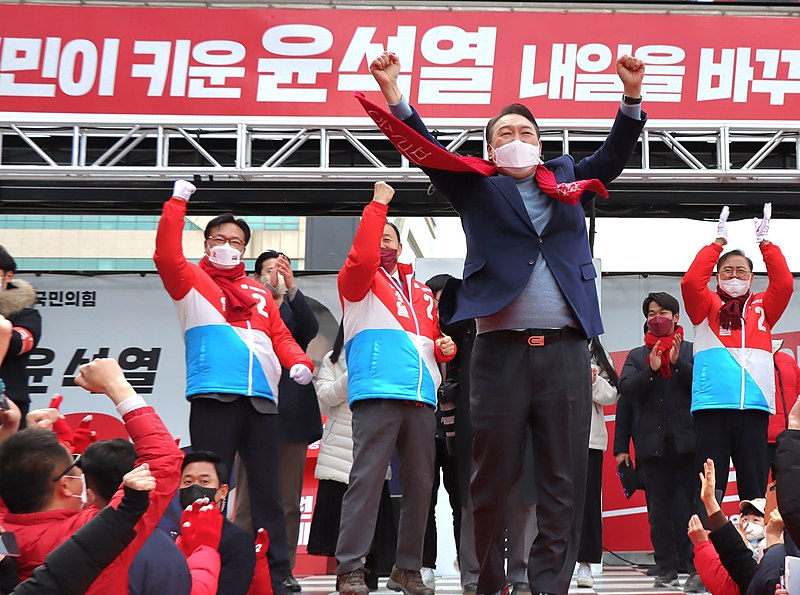
Following a close and bitter presidential race, South Korea has elected its new leader. Conservative opposition candidate Yoon Suk-yeol won the presidency, defeating his liberal rival Lee Jae-myung.
Yoon was elected to the presidency in South Korea this week in a close race between him and Lee. The conservative candidate won 48.6 percent of the country’s votes while Lee had 47.8 percent, from over 98 percent of votes that were counted. Yoon will be succeeding outgoing president Moon Jae-in, for a five-year term and will take office in May.
Yoon, who is a former top prosecutor, said Thursday that he intends to honor the Constitution and the parliament while working with the opposition parties when he takes office. Yoon said that his election was a “victory for the great people.” Yoon also thanked Lee and his other rival candidates in his acceptance speech.
“Our competition is over for now,” said Yoon. “We have to join hands and unite into one for the people and the country.”
In a separate event with supporters, Yoon also said that as president, “national unity” would be among his top priorities, along with his belief that all people should be treated equally regardless of their political, regional, and socioeconomic differences.
When it came to foreign policies, Yoon said that he intends to deal with provocations from North Korea sternly and seek to ramp up trilateral security cooperation with the US and Japan. An enhanced alliance with Washington would also be at the forefront of Yoon’s foreign policy while taking a more assertive approach on China.
Voter turnout during this year’s elections was at 77.1 percent with a record early voting, despite concerns that ballot counting would take longer due to the votes from COVID-19 patients. Around 44 million South Koreans 18 years old and above were eligible to vote. During early voting last week, 16 million ballots were cast.
With Yoon as the next president, he is set to face a host of challenges plaguing the country, with a low birth rate, rising house prices, and the effects of the COVID-19 pandemic on the country.













