


 Fed’s Hammack Says Bond Yield Surge Is Not Driven by Inflation Fears
  David Schwartz to Reveal XRP Ledger Future at Ripple Swell 2026
  Yen Sinks as BOJ Rate Hike Fails to Impress Markets
  Stellar Overtakes Ethereum in RWA Fund Inflows as XRP Leads Commodities
  XRP Whale Activity Drops 27% in Eight Days Amid Market Sell-Off
  ECB May Stop Rate Hikes After December, Capital Economics Says
  RBI Uses $10 Billion Currency Swaps to Drain Excess Rupee Liquidity
  RBI Raises Repo Rate to 5.50% in Hawkish Shift on Inflation Risks
  BNB Price Faces Pressure as DOJ Investigates Binance
  GRAM Price Jumps 9% as Telegram Expands Money Wallet
  Fed Minutes Signal Another Rate Hike by Year-End
  Bitcoin Rebounds to $82K as Trump Eases Iran War Fears


 Add as a preferred source on Google
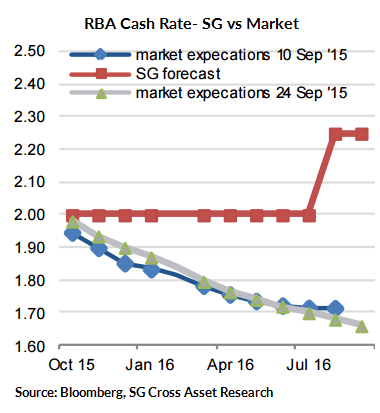
Australia's current cash rate stands at a record low of just 2 percent after the RBA slashed rates by 25 basis points, or 0.25 per cent, in both February and May this year. Market and most analysts believe interest rates will remain unchanged when the RBA announces its decision on Tuesday, 6th October. However, there is a growing chorus of economists who believe there will be further interest rate cuts in the near future.
The RBA Board does not seem to be under any pressure to alter the policy stance at this stage. The board appears to have become more optimistic about growth in the non-resource sector. RBA Governor, Glenn Stevens sounded pretty relaxed in testimony before Parliament. In an unusually forthright comment the central banker said: "The question has been more for us: should we hold or go down a bit more. And I think we're pretty content where we are right now."
Indeed, Australia has for so long been one of the key beneficiaries of China's monstrous economic growth. But with the world's second-biggest economy now experiencing a sharp slowdown, there are fears of a hard landing locally with many economists predicting what could be a first recession in Australia in 24 years.
"We maintain our view that for this cycle the bottom in the policy rate has been reached. However, should risks such as a hard landing in China or a sudden property crash in Australia materialise, the RBA has substantial scope to ease policy further, and would not hesitate to use it", notes Societe Generale in a research note.
However, interest rates and exchange rates are doing their job of stimulating Australia's economy and assisting in the major rotation of sources of growth. The RBA has apparently shifted its view about the exchange rate, now that its desire of a weaker exchange rate seems to have been achieved. This does not mean that the exchange rate will not depreciate further - some further weakness is expected in the near term - but it does strongly suggest that one of the motivating factors for the RBA to cut interest rates is no longer in play.
"We very much agree with the assessment that low interest rates and the materially weaker exchange rate are helping the Australian economy to successfully make the shift from resource investment to other sources of growth such as non-resource exports, residential investment and private consumption", says Societe Generale in a research note.
The Australian dollar underperformed most of the majors in September and entered October just above its YTD, multi-year lows near 0.6900. Given the potential for further turbulence in China and continued weakness in commodity prices, AUD is likely prone to further weakness. AUD has few meaningful long-term technical support levels above its crisis lows around 0.63. AUD/USD is seen trading at 0.7098 at 1020 GMT.

- News

- Economy

- Central Banks
- Investing
- Research
- Roundups
- Digital Currency
- Insights
- Technical Analysis
- Technology
- Business
- Law
- Health
- Nature
- Fintech
- Science
- Topic
- Opinions
- ©Econometrics LLC . All Rights Reserved.
RBA to stand pat in Oct policy meet, weakness expected in exchange rate
Monday, October 5, 2015 11:19 AM UTC
Editor's Picks



- Market Data
Most Popular




