


 Fed Unveils Stablecoin Rules Under GENIUS Act
  FxWirePro- Crypto Weekly Alpha: ETF Rebounds, L2 Rallies & Key Resistance Levels
  BOJ Raises Interest Rate to 31-Year High as Yen Weakens
  fnny Beta Launches With a Simple Idea: Find an Event, Show Up, Get Rewarded
  Yen in Focus as BOJ, Fed Rate Hikes Reshape Currency Markets
  Hawkish Fed Fuels Gold Sell-off: Gold Dives Below $4300 Amidst Rate Hike Fears
  FxWirePro- Crypto Weekly Alpha: ETF Rebounds, L2 Rallies & Key Resistance Levels
  ECB Rate Hike in Focus as Oil Tops $100
  European Stocks Rally on Chinese Growth and Mining Merger Speculation
  Who should own the knowledge that underpins AI technology?


 Add as a preferred source on Google
The current price action in the euro remains choppy but essentially range-bound. The trade-weighted index gained 2.5% in the month to mid-September on what seemed like a re-think of the euro’s exposure to Turkey, but then gave back around 1.5% over the past few weeks as Italian stress came to the fore and the dollar was buoyed by the re-think of Fed policy. Over the past 24 hours the euro has turned higher once again as equities have slumped as this has caused a de-risking of the (small) short EUR positions the spec market had established over Italy.
Looking through the month-to-month gyrations we are holding our forecasts steady this month. The end- 2018 projection for EURUSD is modestly lower (1.130) and predicated on a combination of 1) continued divergence in near-term macro-economic momentum between the US and the Euro area and 2) probable further tensions over Italy’s budget if, as seems likely, this is rejected by the EU Commission. The possibility that the BTP spread could overshoot towards 400bp and in turn de-stabilise banks justifies downgrading the risk bias around this forecast from bullish to neutral.
Beyond that, we continue to expect a progressive but nevertheless shallow uptrend in EURUSD through next year to 1.19 to reflect 1) a closure of the growth gap between the US and Euro area from 1.5% so far this year, and 2) a probable improvement in rate spreads in the euro’s favour as the ECB delivers rather more tightening than the curve prices. We continue to believe that delivery of early stage ECB tightening should be more impactful for FX than an extension of late-cycle Fed hikes as the market is liable to become more concerned about the longevity of the US cycle if the Fed is confronted.
After Italian spreads (10 year against Bunds) had climbed to 340bp on Friday morning they collapsed back to 300bp again. Only because EU Commis- sioner Pierre Moscovici seemed to find conciliatory words and explained the EU Commis- sion did not want to influence the economic policies of the Italian government. The euro also recovered in line with the Italian spreads.
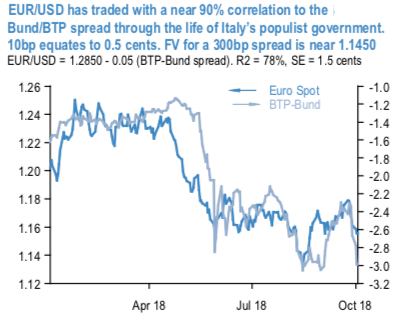
There has been an impressive degree of co-movement between EURUSD and the Italian risk premium ever since the previous Italian parliament was dissolved last December. The correlation through this period is close to 90%, dominated of course by the fraught period following the election in March as investors came to terms with an implausible coalition of populists and the euro sank by nine cents and the Bund/BTP leapt by 175bp (refer above chart). Courtesy: JPM
Currency Strength Index: FxWirePro's hourly EUR spot index is inching towards 36 levels (which is mildly bullish), while USD is flashing at 58 (which is bullish), while articulating at (08:15 GMT). For more details on the index, please refer below weblink:







