


 S&P 500 Relies on Tech for Growth in Q4 2024, Says Barclays
  UBS Predicts Potential Fed Rate Cut Amid Strong US Economic Data
  Japan Economy Minister Downplays Inflation Risks Despite BOJ Warning
  Singapore Central Bank’s Exchange Rate Policy Explained: Why MAS Uses the S$NEER Instead of Interest Rates
  U.S. Treasury Yields Expected to Decline Amid Cooling Economic Pressures
  Brazil Cuts Selic Rate to 14% as Inflation Eases but Risks Persist
  Moody’s Affirms NVIDIA Aa1 Rating as AI Data Center Guarantees Reach $105 Billion
  RBI Holds Repo Rate at 5.25% as Inflation Risks and Global Uncertainty Persist
  Citadel Warns High Treasury Yields Pose Broader Market Risks
  Fed Holds Interest Rates Steady as Kevin Warsh Says Rising Treasury Yields Tighten Financial Conditions
  BSP Sees Philippine Inflation Easing, Keeps Policy Options Open


 Add as a preferred source on Google
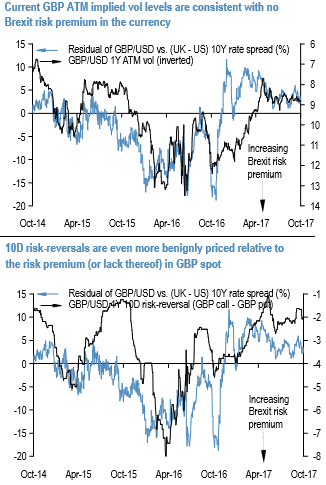
GBP has been a currency with substantial fundamental uncertainty for now in our view. One side Brexit transition and on the other hand, the abrupt change in the BoE’s reaction function triggered a sharp GBP rally in September. However, the trigger for the shift remains unclear and injects a greater-than-usual degree of instability to the path of UK monetary policy.
Politics remains a risk factor for the currency, both at a domestic level where speculation around PM May’s grip on the Tory party and a potential leadership challenge has increased and externally on the Brexit front where the risk of deadlocked UK/EU negotiations going into the December summit and a UK walkout has grown.
These risks are not mutually exclusive either, with a messy feedback loop from Brexit politics to BoE policy potentially exacerbating bearish currency pressures, widening the range of possible outcomes and imparting a fat left tail to the distribution. Yet current levels of GBP implied vols/skews price in almost no policy uncertainty premium.
A simplistic pointer is that GBP ATM vols and skews have retraced more than 100% of their post-Brexit referendum widening from last year even as the pound has reset at a permanently weaker level. A more robust argument is that current GBP vol levels are consistent with zero risk premium in the spot, where the latter is measured as the undershoot relative to a pure interest rate based cyclical framework.
As per the above charts, it demonstrates, the risk premium for policy uncertainty in the currency – both in cash and in vol –is near zero, and this is surprisingly equally, if not more, true for low-delta risk reversals that generally act as reliable repositories of tail risk premium. Thus, it is reckoned that the UK policy uncertainty inadequately priced into GBP options. Courtesy: JPM







