


 Singapore Central Bank’s Exchange Rate Policy Explained: Why MAS Uses the S$NEER Instead of Interest Rates
  RBA Signals More Rate Hikes Possible as Australia Battles Stubborn Inflation
  BOJ Rate Decision in Focus as Sticky Inflation, Weak Yen Shape USD/JPY and Nikkei Outlook
  Morgan Stanley Sees Fed Holding Rates as U.S. Inflation Cools


 Add as a preferred source on Google
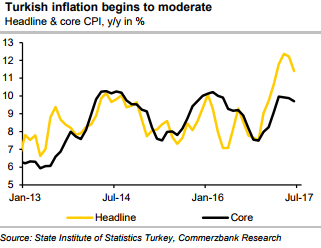
CBRT monetary policy may gradually loosen from here. After roughly 350 bps tightening since the start of the year, the central bank may have fewer reasons to maintain such a tight monetary stance in the months ahead. CPI might have peaked in April as core CPI is trending lower and TRY rallied. n Continuing TRY strength will further augment room for CBRT policy normalization, via both decreasing financial stability risks and limiting the inflationary impact of currency pass-through.
Turkish CPI data for June surprised the markets positively, although one may not see this from yesterday's TRY price action, which was driven more by rising US Treasury yields. But the CPI data themselves were fairly encouraging: the year-on-year inflation rates for both headline and core CPI surprised analysts to the downside; these inflation rates appear to have peaked (refer above chart).
The primary risk scenario is one of potential pressure on CBT to relax its monetary stance. Our own forecast is that CBT will lower its weighted average cost of funding by some 200bps by the end of the year. This should still allow for a positive real interest rate; but, if CBT were to ease policy by a much greater margin, then the lira would once again be exposed to the familiar scenario of sharp, spiraling depreciation. Hence, short 1Y 35D USD puts/TRY calls, delta-hedged, Sell 1Yx1Y USDTRY FVA vs buy 1Y ATM call.







