


 South Korea, US Discuss Warship Building Cooperation
  Asian Currencies Mixed as Dollar Holds Near Two-Month High
  RBI Uses $10 Billion Currency Swaps to Drain Excess Rupee Liquidity
  Trump, Xi Focus on Trade and AI at White House Summit
  Wall Street Ends Flat as Oil, Treasury Yields and Fed Jitters Rattle Markets
  Oil Prices Surge as U.S.-Iran Diplomacy Hopes Fade
  Soybean Futures Slip as Traders Await Trump-Xi Trade Signals
  US Dollar Hits Two-Month High as Fed Rate Hike Bets Rise
  U.S. Dollar Hits Two-Month High as Oil, Treasury Yields Surge
  U.S. 10-Year Treasury Yield Hits 2007 High as Fed Rate Hike Bets Rise
  Mexico-US Trade Talks Delayed to October as Tariff Negotiations Continue
  Fed Unveils Stablecoin Rules Under GENIUS Act
  US 10-Year Treasury Yield at 6% Emerges as New Market Risk Threshold
  Gold Drops Over 1% as Dollar, Treasury Yields Surge on Fed Rate Hike Bets
  China’s ‘Lipstick King’ Says AI Won’t Replace Livestream Hosts
  US, China Extend Trade Truce to Jan. 10 Ahead of Trump-Xi Summit
  Wall Street Falls as Treasury Yields Surge, Oil Rebounds on Iran Tensions


 Add as a preferred source on Google
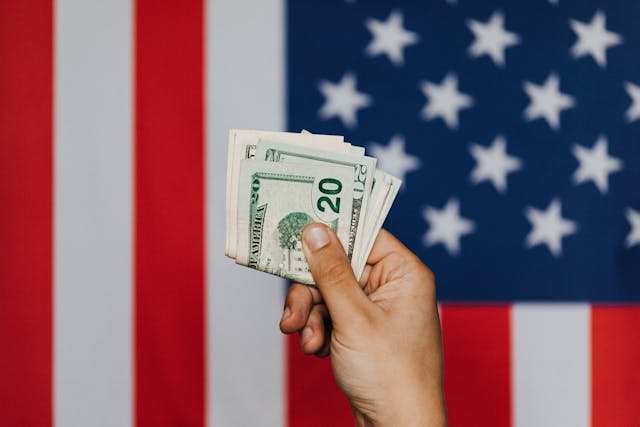
The U.S. dollar edged lower on Friday, extending its decline for a second consecutive session after a six-day winning streak pushed the greenback to its strongest level since May 2025. Despite the modest pullback, the dollar remained on course for a weekly gain as investors continued to weigh expectations that the Federal Reserve could still raise interest rates later this year.
The U.S. Dollar Index (DXY), which measures the greenback against six major currencies, slipped 0.1% to 101.32 by late Friday trading. Even with the decline, the index finished the week approximately 0.5% higher, supported by the Fed’s increasingly hawkish monetary policy outlook.
Investor attention centered on the latest U.S. inflation figures, particularly the May Personal Consumption Expenditures (PCE) Price Index, the Fed’s preferred inflation gauge. Core PCE inflation matched market expectations on both a monthly and annual basis, with the annual reading rising 3.4%—its highest level since October 2023. Headline PCE inflation also met forecasts, recording its strongest yearly increase since April 2023.
Although inflation remained elevated, financial markets slightly reduced expectations for additional Fed rate hikes while increasing bets that policymakers may leave interest rates unchanged in upcoming meetings. Analysts attributed the shift largely to falling oil prices, which have eased inflation concerns following the recent de-escalation of tensions in the Middle East.
Last week's Federal Reserve meeting had already reshaped market expectations after policymakers released a more hawkish dot plot, indicating that at least half of Federal Open Market Committee (FOMC) members now anticipate rate hikes this year. Fed Chair Kevin Warsh also emphasized that restoring price stability remains the central bank’s top priority while signaling that forward guidance would no longer be used as a policy tool.
Deutsche Bank analysts noted that while the latest PCE report broadly supports the Fed's hawkish stance, declining energy prices since the U.S.-Iran memorandum of understanding have become a positive factor for inflation. The bank expects Warsh to remain cautious during next week's remarks, avoiding any direct signals regarding the near-term path of interest rates.
Attention is now shifting toward next week's labor market data, including job openings, weekly unemployment claims, Challenger job-cut figures, ADP private payrolls, and the closely watched U.S. nonfarm payrolls report.
According to Interactive Brokers Senior Economist José Torres, the upcoming employment data will play a crucial role in determining whether the U.S. economy can withstand additional monetary tightening. Strong hiring could reinforce expectations for further Fed action, while signs of labor market weakness may complicate the central bank’s inflation-fighting strategy.
Meanwhile, the University of Michigan's final June consumer sentiment index improved by roughly 10% from the previous month as declining gasoline prices boosted household confidence. One-year inflation expectations also eased slightly, falling to 4.6% from 4.8% in May.
Looking beyond the United States, UBS analysts maintained their view that the U.S. dollar is likely to remain strong throughout the second half of the year, supported by relatively high U.S. interest rates and resilient economic fundamentals.
In Asia, the Japanese yen weakened modestly after strengthening over the previous four sessions, with USD/JPY trading around 161.75. The yen remains under pressure due to the significant interest rate gap between Japan and the United States, despite Tokyo inflation data showing steady underlying price pressures. Markets continue to monitor the currency closely as levels above 160 have historically prompted intervention by Japanese authorities.
Elsewhere, Malaysia's ringgit emerged as Asia's best-performing currency on Friday, with USD/MYR falling about 0.7%. South Korea's won also strengthened by roughly the same margin against the U.S. dollar.
The Australian dollar slipped around 0.2% after stronger-than-expected inflation and labor market data reinforced expectations that the Reserve Bank of Australia will maintain restrictive monetary policy, although investors remain divided on whether another interest rate increase will ultimately be necessary.







