


 South Korea Weighs AI Profit Sharing as Samsung and SK Hynix Earnings Surge
  Quantinuum Raises $1.68 Billion in Upsized Nasdaq IPO Amid Growing Quantum Computing Demand
  DeepSeek Targets $7.4 Billion Funding Round, Valuation Could Reach $59 Billion in 2026
  MOL Gets More Time to Negotiate Acquisition of Russian-Owned Stake in Serbia’s NIS
  CrowdStrike Beats Q1 FY2027 Expectations, Raises Outlook Despite After-Hours Stock Decline
  Lynas Rare Earths Names Pol Le Roux as Interim CEO Ahead of Leadership Change
  Palo Alto Networks Q3 FY2026 Earnings Surge on Strong AI Security Demand, Raises Full-Year Outlook
  Bouygues, Orange and Iliad Strike €20.35 Billion Deal to Acquire SFR
  Airbus Aircraft Deliveries Surge in May 2026
  Netflix Names Jay Hoag as Board Chairman Following Reed Hastings’ Departure
  CBS News Fires Scott Pelley Amid Major Changes at ‘60 Minutes’ in 2026
  Apollo Ends Pursuit of Bodycote, Withdraws £1.52 Billion Takeover Proposal
  Honeywell Aerospace Targets $6.5 Billion Earnings by 2030 After Spin-Off
  Switch Eyes Multi-Billion-Dollar Funding Round at $50 Billion Valuation Ahead of Potential IPO
  US Officials Explore AI Company Equity Stakes Ahead of OpenAI and Anthropic IPO Plans
  Jensen Huang Strengthens Nvidia’s South Korea Ties Amid AI Expansion
  Foreign Firms Cash In on India's IPO Boom


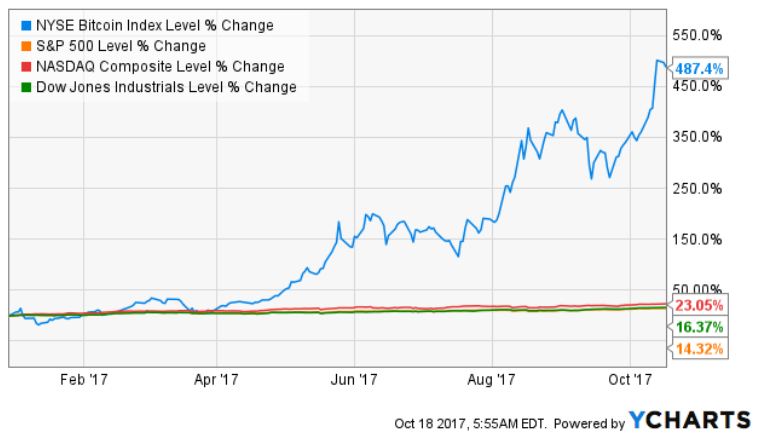
Blockchain technology is probably the most disruptive technology in the market right now. Businesses, organizations, and governments are starting to pay extra attention to the latent ability of Blockchain technology to disrupt many industries. Bitcoin, a cryptocurrency built on Blockchain technology has shown incredible potential to outperform other traditional assets such as stocks, as seen in the chart below.
Bitcoin is up 487.4% in the year-to-date period – in contrast, the S&P 500 is up 14.32%, the NASDAQ is up 23.05%, and the Dow Jones has gained 16.37% in the same period.
Bitcoin has delivered impressive performance in promoting Blockchain technology; yet, Bitcoin is one only of the many different applications of Blockchain technology. Smart Contracts are building up momentum to become one of the biggest uses of Blockchain to trigger strategic paradigm shifts across a wide range of industries and economies.
What are Smart Contracts?
Smart Contracts are simply a set of self-executing agreements that perform a predefined action at the event of another action. Using the "if this, then that, logic" smart contracts follow a set of predefined rules to facilitate the exchange, distribution and payments of goods and services. One of the key features of smart contracts built on Blockchain technology is that it improves the transparency in the immutability of the terms of a contract. Smart contracts can also reduce the odds of conflict in the event of a breach of contract or underperformance by any of the parties in the deal.
For instance, a smart contract can solve the trust and security issue between a freelance graphics designer and a client. A client that needs the services of a graphics designer won't want to pay upfront because the freelancer could disappear with the money without designing anything, The freelancer might also be hesitant to design stuff and get paid after delivery because the client can escape with the design without paying any or all of the agreed fee.
A smart contract lets the client put money in an escrow account. The client can't take money out of the account unless approved by the freelancer. The freelancer in turn uploads the graphics file in a view-only format that can't be downloaded. If the client views, approves, and download the file, the funds held in escrow are automatically released to the freelancer.
Confideal eliminates the legal and coding hurdles needed limiting smart contracts
Smart contracts sound great in theory; but they tend to be difficult to pull off in practice. To begin with, not many people understand the how the legal system works enough to create a contract that makes sense in the eyes of the law. Hence, hiring lawyers to draft up self-executing smart contracts will only jack up the cost of getting legal service. Secondly, very few people have the technical expertise to write the code for creating and executing smart contracts on Blockchain.
Confideal is setting up shop to become the perfect solution for using smart contracts to facilitate deals. With a visual smart contract editor, users can create useable smart contracts without any prior legal or coding knowledge. Confideal is built around the understanding that the business relationships can be faster, easier, and more readily accessible across borders through the instrumentality of smart contracts built on Blockchain.
With Confideal's revolutionary smart contract builder, anybody can create an enforceable, self-executing and secure digital agreement powered by Ethereum for all types of transactions. Confideal's smart contract can be used by cryptocurrency startups to issue ERC20 tokens, make ICO contracts, and ordering mining equipment. Businesses can use Confideal for large-term contracts with delayed payments.
On Confideal, the terms of a contract are encrypted and protected on the Ethereum blockchain; hence, it is impossible for any party to alter the terms of a deal without the knowledge and approval of the counterparty. Confideal also has a built in arbitration model that can be used to resolve disputes in the execution and enforcement of the terms of the contract.
The best part is that you can create, execute contracts, and go to arbitration on Confideal's smart contract platform without sharing or revealing any personal information. The Confideal ecosystem makes it easy to get manage the different areas of the contract such as; setting up fines, closing a deal, or closing a deal.
Cryptocurrencies will drive the growth of smart contracts
One of the underlying pressure points that could make it somewhat difficult for smart contracts to take off is payments. Traditional financial institutions are simply not in the position to support the creation of smart contracts (which are digital) with fiat currencies (which are physical). Thankfully, cryptocurrencies simply eliminates the barriers to payments by removing intermediaries in order to lower costs
Confideal is preparing to launch an in-platform cryptocurrency, the Confideal Token (CDL) that will be used for facilitating deals on the Confideal platform. CDL tokens also helps counterparties avoid the usual 1% service fee that is usually charged on contracts in fiat transactions. The CDL token can also be exchanged for other ERC20 tokens on the Ethereum platform at a 33.3% discount.
The demand for the CDL token is potentially huge as smart contracts built on blockchain garners mainstream adoption. Interestingly, Confideal is giving cryptocurrency investor a first-mover advantage into the cryptocurrency industry with the CDL token sale planned for next month. Confideal had originally raised about $650,000 in the presale of the CDL token in August; and now, the ownership of the CDL token is about to be opened to accredited investors.







