


 NASA Resumes Cygnus XL Cargo Docking with Space Station After Software Fix
  Tabletop particle accelerator could transform medicine and materials science
  Neuralink Plans High-Volume Brain Implant Production and Fully Automated Surgery by 2026
  Lost in space: MethaneSat failed just as NZ was to take over mission control – here’s what we need to know now
  NASA Astronauts Wilmore and Williams Recover After Boeing Starliner Delay
  CDC Vaccine Review Sparks Controversy Over Thimerosal Study Citation
  Blue Origin’s New Glenn Achieves Breakthrough Success With First NASA Mission
  Eli Lilly’s Inluriyo Gains FDA Approval for Advanced Breast Cancer Treatment
  Neuren Pharmaceuticals Surges on U.S. Patent Win for Rare Disorder Drug
  FDA Lifts REMS Requirement for CAR-T Cell Cancer Therapies
  Is space worth the cost? Accounting experts say its value can’t be found in spreadsheets
  SpaceX Starship Explodes in Texas During Test, Citing Nitrogen Tank Failure
  Trump Administration to Launch Autism Initiatives Targeting Acetaminophen Use and New Treatment Options


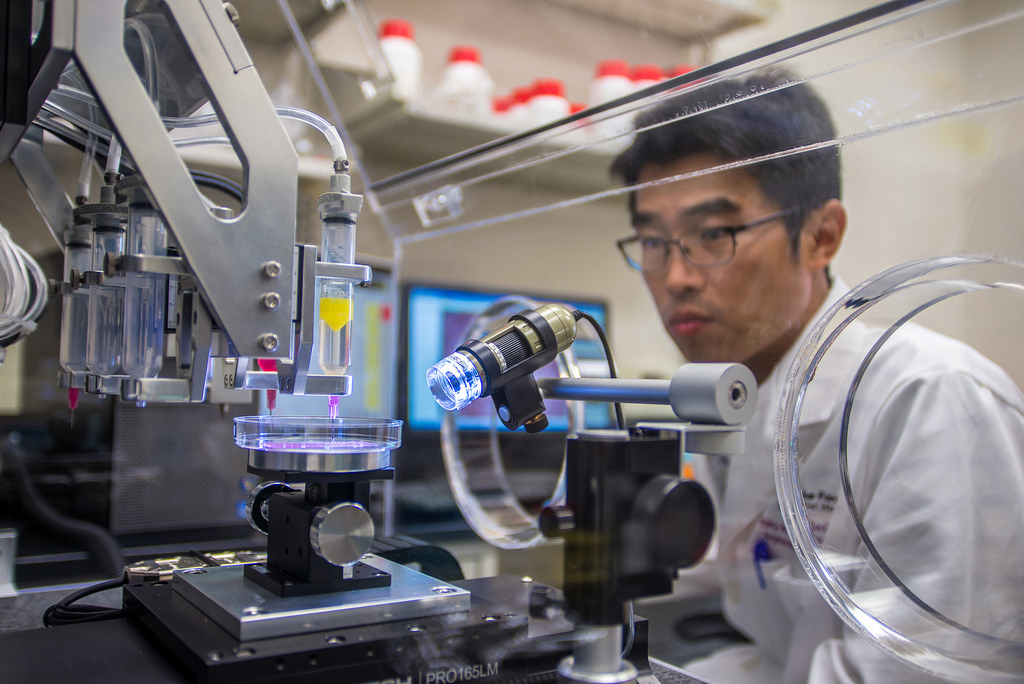
When most people think of 3D-printing, they imagine plastic or metal objects such as furniture or machine parts. However, scientists have been working on printing living tissue as well, which would allow scientists to create artificial organs. This is exactly what a team of researchers managed to advance recently, which could solve the problem of the dreaded transplant list.
This new method was created by University of Oxford researchers, which took 3D bioprinting to a whole new level. Publishing their findings on the scientific journal Nature Communications, the researchers explain how their 3D-printed organs are able to maintain their shape, which has been a huge problem in this field.
“Human embryonic kidney (HEK) cells and ovine mesenchymal stem cells (oMSCs) were printed at tissue-relevant densities (107 cells mL−1) and a high droplet resolution of 1 nL. High-resolution 3D geometries were printed with features of ≤200 μm; these included an arborised cell junction, a diagonal-plane junction and an osteochondral interface. The printed cells showed high viability (90% on average) and HEK cells within the printed structures were shown to proliferate under culture conditions,” the paper reads.
The project was led by Alexander Graham, a specialist in 3D bioprinting. By essentially containing the cells printed in nanolitre droplets, which were then coated with a lipid wrap, the researchers were able to maintain the resulting tissue construct’s integrity.
What really makes this new method so impressive, is the fact that it allows scientists to more closely mimic actual organic tissue, Futurism reports. As a result, there is a lower chance of rejection on the part of the patient who will be hosting the organs created by the method.
In a recent press release, Graham explained exactly what they were hoping to achieve with this new method.
“We were aiming to fabricate three-dimensional living tissues that could display the basic behaviors and physiology found in natural organisms,” he said.













