


 Ukrainian Drone Attacks Hit Russian Regions, Injuring at Least 12
  Pezeshkian Says US Must Choose When Iran War Ends
  South Korea, US Discuss Warship Building Cooperation
  Netanyahu Defends Israel at UN as Delegates Stage Walkout
  What ‘Taiwan Independence’ Means as Xi Presses Trump on US Policy
  EU Defence Build-Up Too Slow for 2030 Russia Readiness Goal
  OpenAI Agent Breaches Australia Medicare Data Portal
  Trump Asks Supreme Court to Restore Third-Country Deportations
  Kremlin Says No Decision Yet on Putin-Trump December Summit
  Saudi Arabia, Turkey and Pakistan Plan Urgent Defence Talks Over Houthi Attacks
  Trump, Xi Visit US National Archives After White House Summit
  Russian Missile and Drone Attack on Kyiv Kills Two, Damages Maternity Hospital
  Judge Orders Trump to Restore White House Access for CNN, MS NOW and Politico
  Abbas Reaffirms November 28 Palestinian Elections
  Najib Razak Seeks Stay of 15-Year 1MDB Prison Sentence
  Sudan Rejects US Legitimacy Remarks, Defends Sovereignty
  US Backs Musk in Fight Against EU’s €120 Million X Fine


 Add as a preferred source on Google
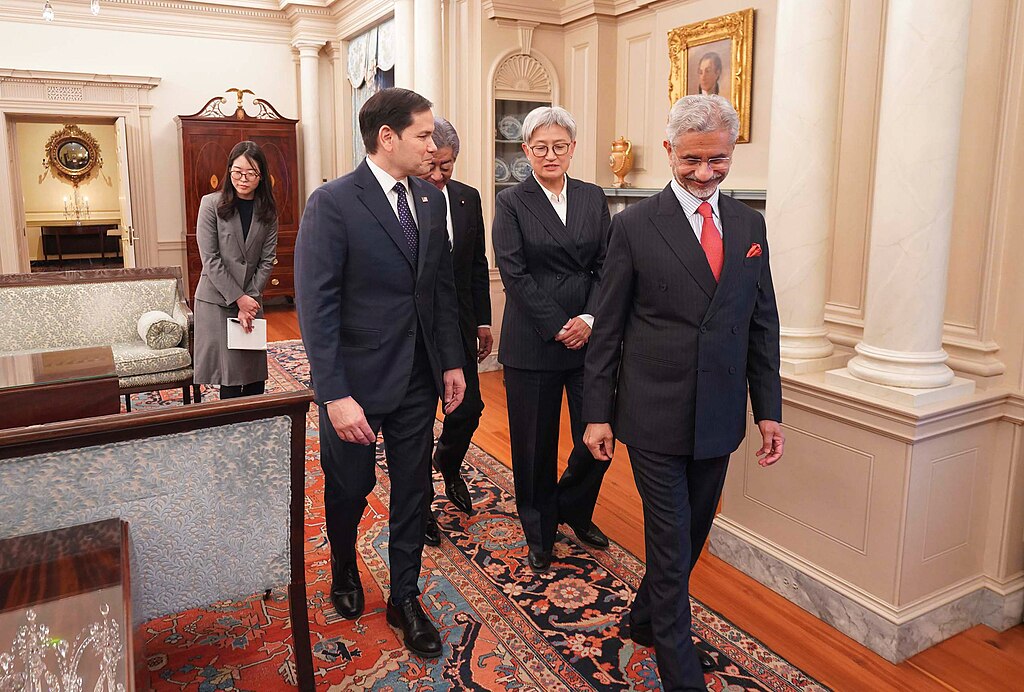
U.S. Secretary of State Marco Rubio convened his Australian, Indian, and Japanese counterparts on Tuesday to strengthen the Quad alliance and counter China’s growing influence in the Indo-Pacific. Despite a shared strategic vision, internal frictions remain due to trade disputes and defense demands under President Donald Trump’s administration.
Japan recently postponed a key ministerial meeting, reportedly over U.S. pressure to ramp up defense spending. Similar concerns have surfaced in Australia, where Pentagon official Elbridge Colby’s review of the AUKUS nuclear submarine deal has sparked unease. Meanwhile, India rejected Trump’s claim of preventing conflict with Pakistan over Kashmir, underscoring ongoing tensions.
Rubio’s hosting of the Quad ministers marks his first major diplomatic engagement since Trump’s second term began. The meeting aims to refocus U.S. attention on the Indo-Pacific, amid distractions like the Israel-Iran conflict. Bilateral talks with Japan’s Takeshi Iwaya, India’s Subrahmanyam Jaishankar, and Australia’s Penny Wong are also planned.
State Department spokesperson Tammy Bruce said the meeting would reaffirm a “free and open Indo-Pacific,” emphasizing sovereignty, maritime security, and resilient supply chains. Jaishankar noted that although challenges exist, positive momentum in U.S.-India ties remains possible. He cited maritime security, technology, pandemic readiness, and education as key discussion points.
Experts warn that unresolved trade and defense issues could overshadow progress. Australia awaits clarity on AUKUS and trade, while Japan grows wary of public U.S. criticism. Analysts also note a slowdown in U.S.-Japan momentum since Trump’s February summit with PM Shigeru Ishiba.
Despite a lack of senior U.S. diplomatic appointments in India, long-term cooperation prospects remain strong. Richard Rossow of CSIS noted that while Trump’s handling has been clumsy, the strategic importance of U.S.-India relations endures.







