


 FDA Lifts REMS Requirement for CAR-T Cell Cancer Therapies
  Is space worth the cost? Accounting experts say its value can’t be found in spreadsheets
  Jared Isaacman Confirmed as NASA Administrator, Becomes 15th Leader of U.S. Space Agency
  Blue Origin’s New Glenn Achieves Breakthrough Success With First NASA Mission
  Lost in space: MethaneSat failed just as NZ was to take over mission control – here’s what we need to know now
  SpaceX Starship Explodes in Texas During Test, Citing Nitrogen Tank Failure
  Astronomers have discovered another puzzling interstellar object − this third one is big, bright and fast
  SpaceX Prioritizes Moon Mission Before Mars as Starship Development Accelerates
  Neuralink Expands Brain Implant Trials with 12 Global Patients
  Cogent Biosciences Soars 120% on Breakthrough Phase 3 Results for Bezuclastinib in GIST Treatment
  Neuren Pharmaceuticals Surges on U.S. Patent Win for Rare Disorder Drug
  Trump Administration to Launch Autism Initiatives Targeting Acetaminophen Use and New Treatment Options
  Trump and Merck KGaA Partner to Slash IVF Drug Costs and Expand Fertility Coverage
  SpaceX’s Starship Completes 11th Test Flight, Paving Way for Moon and Mars Missions


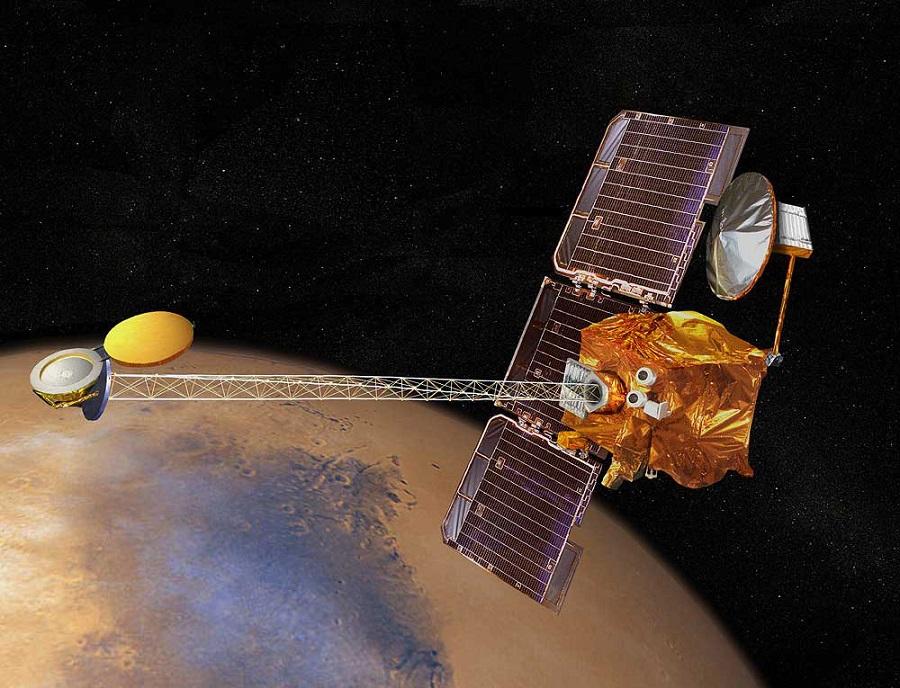
The National Aeronautics and Space Administration (NASA) currently has several operations in space, and some of them are taking place on Mars. While many of the images and data being gathered by the agency have yet to be fully explained, some UFO and ET enthusiasts are already coming up with their own interpretations.
Did NASA capture an image of ancient Martian building?
One of the NASA equipment currently deployed in Mars is called the Curiosity rover as part of the Mars Exploration Program. It landed in the Red Planet in 2012, and a recent image it took stirred the interest of a well-known UFO enthusiast.
Scott Waring of the ET Database took particular interest in the panoramic image taken by the Curiosity rover last Aug. 8 at Mars, Sol 981. The image is available through the GigaPan website. The UFO expert wants his followers to take a closer look on the left side of the photo. Waring’s article suggests that one particular rock is built as a doorway and provides entrance to a Martian structure.
The supposed doorway is purportedly made by hand and with materials that can be found on Mars such as a type of clay, not bricks. Waring also suggested that the structure was built with similarities with houses on Earth – it is painted and the roof is designed with a triangular shape. Waring added to his speculations that the Mars building could be around 2 meters in height, but 95 percent of the structure is part of the underground surface. Astronauts
NASA finds greater magnetic pulsations than expected
Aside from the Curiosity rover, NASA also has the Interior Exploration using Seismic Investigations, Geodesy, and Heat Transport (InSight) lander monitoring natural activities on Mars. One of the latest and interesting data that aeronautics and space experts observed revealed something unexpected about the magnetic field in Mars.
NASA found that the Mars magnetic field pulsates 20 times greater than expected at night. Experts have yet to determine other details, including whether the magnetic signals are coming from underground or closer to the Mars surface. But planetary geologist Paul Byrne told National Geographic that these observations are still important because it gives them more historical information on the magnetic field activities in Mars.













