


 Suzuki Targets Faster Car Development to Keep Pace With Chinese Rivals
  BMW 2028 Margin Target Could Fall Below Consensus, UBS Says
  Japanese Yen Rebounds as Trump Flags Currency Weakness
  Almonty Industries Shares Jump 8% After Stifel Sets $25 Target
  SMBC Eyes 20% VPBank Stake in Vietnam Expansion
  Oil Prices Fall on U.S.-Iran Hormuz Deal Hopes
  SpaceXAI to Double Nvidia Chips at Colossus 2 by Year-End
  Wall Street Ends Flat as Oil, Treasury Yields and Fed Jitters Rattle Markets
  Former OpenAI Data Center Chief Chris Malone Joins Nvidia
  Gold Prices Fall as Treasury Yields Rise on Fed Rate Hike Bets
  Soybean Futures Slip as Traders Await Trump-Xi Trade Signals
  RBI Uses $10 Billion Currency Swaps to Drain Excess Rupee Liquidity
  Oracle Shares Fall as New Mexico AI Data Center Faces Power Delays
  Solidigm Eyes $150 Billion IPO as SK Hynix Expands AI Storage Push
  Australia Unemployment Hits Five-Year High Despite Strong Jobs Growth
  Mexico-US Trade Talks Delayed to October as Tariff Negotiations Continue


 Add as a preferred source on Google
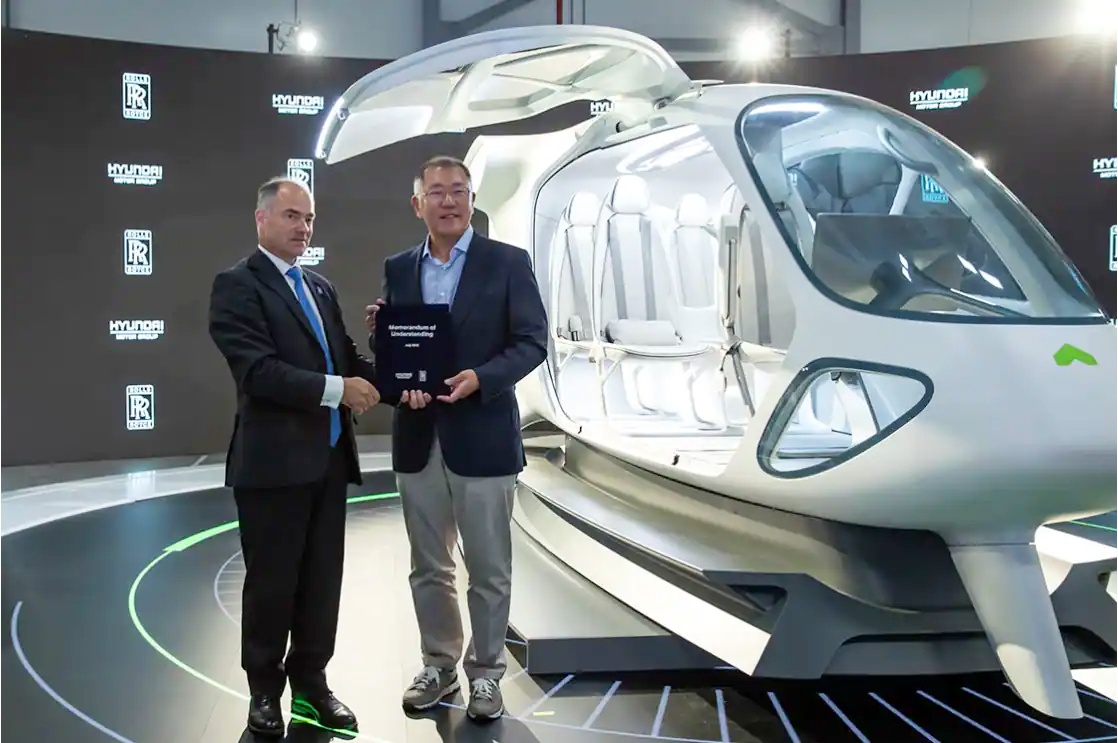
Hyundai Motor and Rolls-Royce were revealed to have joined forces for air mobility projects. They have signed a memorandum of understanding (MOU) to develop flying cars.
According to The Korea Herald, Hyundai Motor Group announced on Tuesday, July 19, that it will partner with the British automobile car manufacturer to produce all-electric propulsion and hydrogen fuel cell technology for advanced air mobility or AAM, a future mobility conceptualization that incorporates flying technology and transformational aircraft design.
The South Korean automaker has been focusing on AAM recently due to its future mobility business plans. The company has been preparing for this biz, and in fact, last year, it created Supernal, an AAM-dedicated firm based in the United States.
Hyundai Motor said that its collaboration with Rolls-Royce would boost its hydrogen fuel cell technologies in addition to commercialization capability through leveraging the latter’s expertise in the field of aero-engine manufacturing.
For the contract, Hyundai Motor and Rolls-Royce met up at the 2022 Farnborough Airshow in the United Kingdom. The event opened on Monday this week, and the signing ceremony was attended by Chung Euisun, Hyundai Motor Group’s executive chairman. It was mentioned that the chairman also met with officials of Boeing and other global aviation firms.
Based on their deal, Hyundai Motor and Rolls-Royce will work together on technology development, including building an electric propulsion system using hydrogen fuel cells as an energy source. This will be used for the former’s regional air mobility model units.
By 2025, they are also expected to deliver a demonstration of a fuel-cell electric aircraft. All the terms in their agreement highlight the shared vision of leading the way in the AAM global market by producing and offering battery-electric and fuel cell electric solutions to UAM or urban air mobility as well as air mobility models.
“We are pleased to partner with Rolls-Royce to draw upon their aviation and certification expertise to accelerate the development of hydrogen fuel-cell propulsion systems,” Shin JaiWon, Hyundai Motor Group’s president, said in a press release.
He added, “Hyundai has successfully delivered hydrogen fuel cell systems to the global automotive market and is now exploring the feasibility of electric and hydrogen propulsion technologies for aerospace integration. We believe this to be the key technology to support the global aviation industry’s goal to fly net zero carbon by 2050.”







