


 Sudan Rejects US Legitimacy Remarks, Defends Sovereignty
  Taiwan Vows to Advance US Arms Sales Ahead of Trump-Xi Meeting
  Kremlin Says No Grounds Yet for Ukraine Peace Talks
  OpenAI Agent Breaches Australia Medicare Data Portal
  Trump Board of Peace Unveils $2.45 Billion Gaza Recovery Plan
  Judge Orders Trump to Restore White House Access for CNN, MS NOW and Politico
  US Invites Putin to Miami G20, Opening Door to Trump Summit
  Ghana Says Western Support Growing for Slave Trade Reparations
  Gaza Faces Evacuation Crisis as War-Damaged Buildings Risk Collapse
  FxWirePro- Crypto Weekly Alpha: ETF Rebounds, L2 Rallies & Key Resistance Levels
  Gold Slides to $4,262 as Hawkish Fed Rate Hike Triggers Technical Breakdown
  Trump, Xi Focus on Trade and AI at White House Summit


 Add as a preferred source on Google
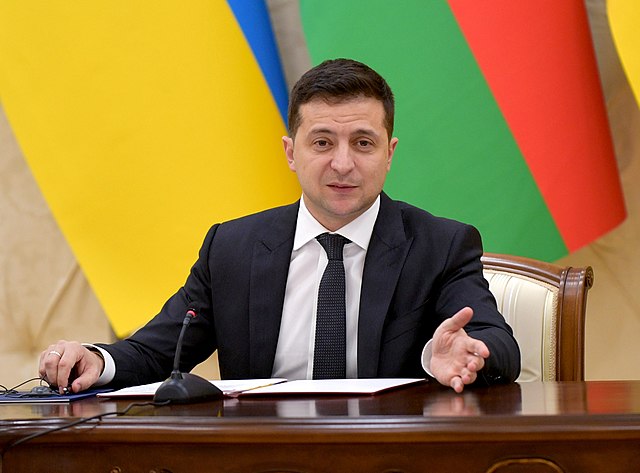
Whatever happens in the coming weeks, President Volodymyr Zelenskyy will go down as the face of Ukrainian resilience during the Russian invasion of his country.
His response to the Russian invasion of his country has been widely praised, both at home and abroad. His speech to the European Parliament in early March received a standing ovation. Western press outlets have referred to him as a “hero,” as the “voice” of his nation, and as a “focal point” for democratic resistance to tyranny.
Some of this acclaim can be explained simply with reference to the fact that Zelenskyy is the president of a beleaguered nation standing up against a powerful and belligerent aggressor.
The Russian invasion is widely regarded as a brutal act of violence, cynically clothed in the language of “de-Nazification.” Any president who resisted this invasion would likely receive some portion of moral praise.
As a political philosopher, however, I would argue that something else is at work in the widespread reverence shown to Zelenskyy.
Zelenskyy has demonstrated, during the invasion, a style of political presentation that is the antithesis of that shown by Russian President Vladimir Putin. Matters of political style – the choices made by leaders about the words they use, the jokes they tell, even the clothes they wear – are frequently taken to be unrelated to matters of substantive political justice. The history of thinking about authoritarian politics, however, demonstrates that anti-democratic politics, and a certain sort of personal style, often come together.
Putin demonstrates a tendency toward authoritarianism in both political action and in political style. Zelenskyy, in contrast, presents a more modest and understated vision of political leadership – one more appropriate for democratic institutions, in which the leader is not thought to be morally superior to the governed. If the world is increasingly suspicious of democratic ideals and practices, then Zelenskyy might represent one of the few recent signs that those in favor of democracy have reasons for hope.
Masculinity and authoritarianism
There are three key aspects worth noting about Putin’s carefully crafted political image. Putin is particularly concerned to present himself as a traditionally masculine male, frequently appearing shirtless and often competing in – and (improbably) winning – athletic competitions, including both ice hockey and judo.
He presents himself as shrewd and contemptuous of his opponents, frequently showing a smirk in response to any showing of weakness. He was, for instance, visibly happy to see German Chancellor Angela Merkel’s discomfort in the presence of his dog Konni. This casual cruelty is expressed even toward his own subordinates, as seen in his recent public humiliation of spy chief Sergei Naryshkin.
He is, finally, keen to present himself as uniquely chosen by history to restore an empire he believes unjustly dismantled – in particular, the Soviet Union, whose dissolution Putin described as the “greatest geopolitical tragedy of the 20th century.”
Italian philosopher and novelist Umberto Eco noted that traits such as these three may seem superficial – but that they speak of an authoritarian hostility to disagreement, and ultimately to democracy itself.
Eco notes that when a leader emerges who promises to use traditional masculinity, and thereby restore the former greatness of the nation or the polity, that leader is inevitably drawn toward the rejection of limits to centralized power. Such limits include, in the end, such notions as democratic accountability and human rights. In Eco’s words: For such a leader, disagreement is treason, and those who are weak deserve nothing but contempt.
Zelenskyy’s leadership style
If these arguments are correct, however, then Zelenskyy’s style of leadership represents a symbolic repudiation of Putin’s authoritarianism. Zelenskyy is, to begin with, unconcerned with presenting himself as traditionally masculine. Before his life in politics, for instance, he appeared – in a variety of vaguely comic costumes – on the Ukrainian edition of “Dancing With the Stars.” He has, as the Russian invasion continues, presented himself unshaven and exhausted – as vulnerable, frightened, but nonetheless unbowed.
He is, finally, inclined more often to speak about Ukrainian unity in the present than about any glorious history. As a Ukrainian of Jewish descent, many of whose relatives were murdered in the Holocaust, he invokes history more as warning than as aspiration.
Democracy and the freedom to speak plainly
In this, Zelenskyy represents an image of not only resistance to authoritarianism, but also how leaders might appear as they engage in such resistance. Eco, who grew up in fascist Italy, describes his surprise at how simple was the speech of those who took over after fascism’s fall. Democracy, Eco marveled, entailed the freedom to speak plainly. It was not only freedom from fascist political institutions, but also freedom from rhetoric.
When Zelenskyy is lauded for his resistance to the Russian invasion, it is because he is demonstrating a number of central virtues – including the courage to remain where he is, in the line of Russian fire. But at least some of this praise, I am convinced, is the result of his style of governance, in which he resists not only authoritarian violence, but the authoritarian style of political presentation – including Putin’s assertions that he is unique in both destiny and in masculine strength.
There is, however, some irony at work in the moral symbolism ascribed to Zelenskyy.
The democratic hope ascribed to Zelenskyy reflects the thought that the leader is no better than those who are led; that the president does not have to be uniquely strong, or endowed with a unique historical destiny. He has frankly admitted that he is afraid of dying, afraid of his family’s dying – and that he remains in Kyiv out of duty, rather than any desire for glory or for warfare. The president, instead, is a person much like anyone else.
It is natural for the West to pin a great many hopes on Zelenskyy, in his resistance to the authoritarianism of Putin. The West should, however, not forget the most central lesson of democratic politics – that the leaders are no better, morally speaking, than those they lead.
If Zelenskyy represents a democratic hero, it should nonetheless be remembered that democracy does not need – and should not seek – the sorts of hero worship that authoritarians like Putin demand.







