


 Gold Surges Near 3-Week High as Trump-Iran Ceasefire Eases Geopolitical Tensions
  Oil Prices Crash Nearly 15% After Trump-Iran Ceasefire Deal
  Trump Slams Iran Over Strait of Hormuz Oil Restrictions Amid Fragile Ceasefire
  Asian Stocks Rally on Ceasefire Hopes and Bargain Buying
  Foreign Investors Pour $18.65 Billion into Japanese Stocks Amid Market Stabilization
  Asian Markets Retreat as Gulf Crisis Fuels Oil Surge and Inflation Fears
  Oil Prices Rise Amid Strait of Hormuz Tensions and U.S.-Iran Talks
  Dollar Stabilizes Amid Fragile US-Iran Ceasefire as Markets Watch Hormuz Strait
  China Set to Exit Deflation Cycle in Early 2026, ANZ Analysts Say
  U.S. Stock Futures Surge as Trump Announces Iran Ceasefire, Oil Prices Plunge
  U.S.-China Trade Talks: Trump and Xi Set for Summit Amid Rare Earths Focus
  Gulf Ceasefire Cracks Rattle Asian Markets and Push Oil Prices Higher
  U.S.-Iran Ceasefire: Fragile Truce Raises Hopes for Strait of Hormuz Peace Deal
  U.S. Futures Dip as Iran Ceasefire Faces Early Challenges
  U.S. Inflation Surges in March as Iran War and Tariffs Drive Prices Higher
  Bank of Japan Governor Signals Accommodative Stance Amid Negative Real Rates


Most notably, China has been the major trade partner of Aussies and Kiwis in the recent past which is why we would like to shed some light on Aussie trade exposure with China ahead of RBA’s monetary policy.
Australia is in the global top 20 of countries ranked by their export exposure to China. In terms of the growth in exports, China’s role was even more critical: increases in sales to China alone accounted for almost 80 per cent of all Australian export growth in value terms in 2013-14.
China accounted for roughly AU$155 billion ($117 billion, based on June 2017 exchange rates) in import-export trade with Australia in 2016, including AU$93 ($70.3) billion in Australian exports.
China has been Australia’s most important export market since 2009 and in recent years has been central to our overall export performance. For an instance, it sold China goods and services worth A$107.5 billion in 2013-14, which accounted for almost one in every three export dollars earned over the year.
The China-Australia Free Trade Agreement (ChAFTA), which took effect in December 2015, is a significant addition to the global landscape for international trade. Besides directly affecting companies engaged in import-export trade between Australia and China, ChAFTA also has potential implications for U.S. companies, since China is the largest goods trading partner for the U.S.
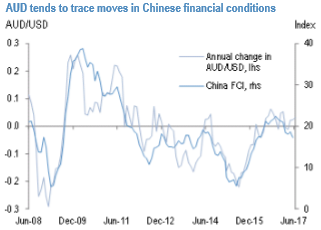
These Chinese data have been volatile in recent months, but AUDUSD looks broadly fair given the twists and turns in Chinese financial conditions of late.
AUD has traced China’s on-again off-again policy shifts on financial conditions and liquidity reasonably well over the past 9 years (refer above chart).
These mini-turns in financial conditions have not been easy to predict ahead of time, the cycle length is shortening, and the transmission to commodities looks more speculative than fundamental.
These cycles have been influential for AUD, and suggest that any further developments by Chinese authorities on this front will bear watching in coming months.
We advocate staying shorts in AUDUSD futures contracts of far-month tenors with a view to arrest downside risks. Courtesy: JPM







