


 Heritage, desire and diplomacy: why China still values scotch whisky
  Columbia Student Mahmoud Khalil Fights Arrest as Deportation Case Moves to New Jersey
  Disaster or digital spectacle? The dangers of using floods to create social media content
  The American mass exodus to Canada amid Trump 2.0 has yet to materialize
  Why have so few atrocities ever been recognised as genocide?
  Stuck in a creativity slump at work? Here are some surprising ways to get your spark back
  Booked to travel through the Middle East? Here’s why you shouldn’t cancel your flight
  6 simple questions to tell if a ‘finfluencer’ is more flash than cash
  The ghost of Robodebt – Federal Court rules billions of dollars in welfare debts must be recalculated
  Yes, government influences wages – but not just in the way you might think
  What’s the difference between baking powder and baking soda? It’s subtle, but significant
  Time to buy local: war fuel price shocks reveal the folly of a long food supply chain
  Can your cat recognise you by scent? New study shows it’s likely
  Want to cut your energy bills? Here’s how five experts are doing it
  Locked up then locked out: how NZ’s bank rules make life for ex-prisoners even harder
  The Beauty Beneath the Expressway: A Journey from Self to Service


 Add as a preferred source on Google


A particularly cold September has given us a glimpse of the winter to come. The cold will bite hardest for the 13% of England’s households that are already in fuel poverty. As the energy crisis intensifies, this is expected to rise further.
European leaders have therefore rushed to implement measures to protect households. The UK’s Energy Price Guarantee caps the unit price of electricity and gas at 34p and 10p respectively. While this will ease some concerns over rising energy bills, many households will still be priced out of warming their home in the coming months.
So here are four ways research indicates households can reduce their energy use in time for the winter – and save money in the process.
1. Air dry laundry
Washing and drying clothing is responsible for around 12% of household electricity use in the UK.
Hand washing is frequently suggested as an energy-saving alternative to machine washing.

Hand washing laundry is often touted as an energy saving alternative to machine washing. aromaso/Shutterstock
Yet modern washing machines are highly efficient, typically using 0.5 kilowatt hours for a 9kg wash. This is considerably less than the 0.82 kilowatt hours used on average by hand washing. Even inefficient washing machines tend to use less energy than hand washing as much less hot water is required.
By instead restricting use of the tumble dryer, greater reductions in energy use can be achieved. Tumble dryers use a lot of energy, with a single cycle using up to 4.5 kilowatt hours. This will cost £1.50 per cycle at the price cap.
By air drying laundry instead, I calculated that the average household could save over £130 a year.
2. Use less hot water
Facing critical gas shortages, the German city of Hanover turned off the hot water in the bathrooms of all public buildings earlier this year.
While energy-saving measures this severe are unlikely, hot water production in the UK is a major consumer of energy, accounting for roughly one quarter of household energy use. There are several ways households can reduce their hot water use.
One way is reducing the time spent in the shower. A high-pressure shower lasting nine minutes uses around 4.3 kilowatt hours of gas. At the price cap, this will cost households 44p per shower. By reducing the time spent showering to six minutes, households can save 15p on heating water for each shower.
If you have a hot water tank, making sure it is well insulated can also deliver cost savings. This will keep water warmer for longer and reduce heating costs.
Another approach is to install a low-flow shower head. This restricts the flow of water while maintaining the feel of a high-pressure shower. At lower flow rates, a shower will consume less hot water. For households that average two nine-minute showers a day, this could save over £100 per year.
However, a low-flow shower head will only work well in areas where the water pressure is already sufficiently high. Reducing the flow of an already low-pressure shower would transform the shower into a dribble.
3. Make better use of heating
As the energy crisis intensifies, it is important to make sure heating is not wasted unnecessarily. Research indicates that energy use could be slashed by up to 30% by reducing heating when occupants are asleep or away.
This can be done by manually dialling down the thermostat or by turning the heating off altogether. For those who habitually forget to lower the heating, a smart thermostat could prove a useful investment. These can be controlled remotely via your mobile, or automatically through presence sensors and allow heating to be lowered when the home is unoccupied.
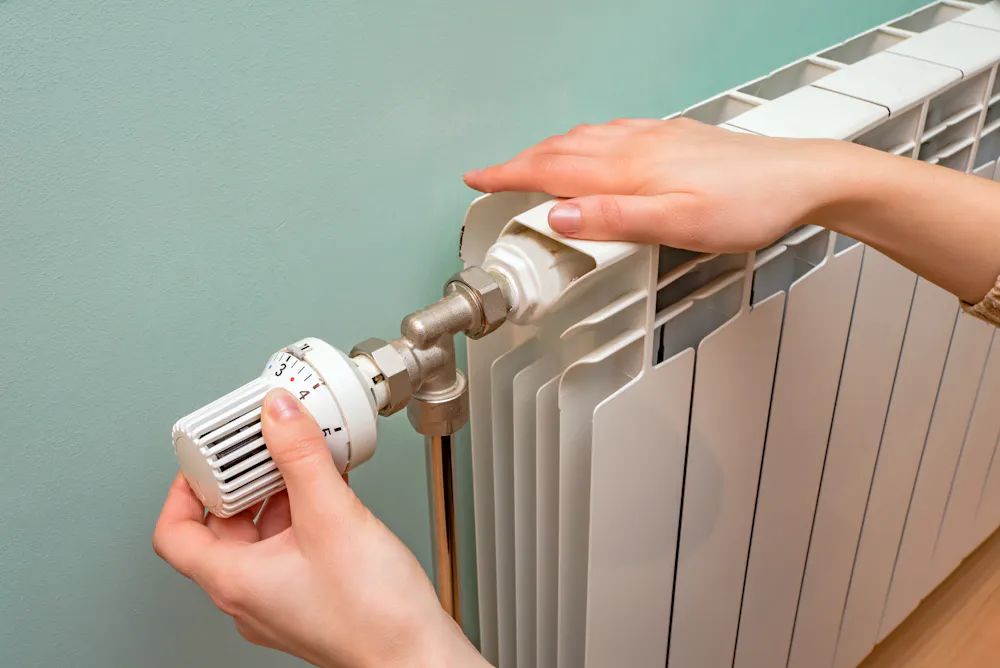
Homes with heating controls use much less energy than homes without. Robert Bodnar T/Shutterstock
Energy is also wasted by heating unused rooms. Thermostatic radiator valves are one way to control the temperature across different rooms. They regulate the flow of hot water through radiators and can be programmed to modulate the temperature for each room.
Thermostatic radiator valves can deliver substantial energy savings. One study found that they result in 10%–18% less energy use compared to homes with no heating controls. However, it is important that the doors between rooms remain closed to prevent energy being wasted.
4. Maximise insulation
Although we can make better use of heating, Britain’s homes are hugely energy inefficient. Its housing stock is one of the least insulated in Europe.
Maximising your insulation is one way to reduce your energy use. Secondary glazing in the form of window shutters can halve the amount of heat lost through a single glazed window. I calculated that this could save the average UK home over £50 per year in heating costs.
But window shutters do not always represent an immediate energy-saving strategy. Shutter installation can be costly and if installed on a building’s exterior may require planning permission.
Closing blinds or curtains at night and during cold spells instead represents a cheaper way of retaining heat. Research indicates that blinds can reduce the amount of heat lost through windows by up to 38%.
Changes in habits and small investments can substantially reduce energy consumption. If widely implemented, they can ease the energy crisis. While the Energy Price Guarantee will provide temporary relief to many, investment in energy efficiency measures such as insulation must be prioritised to reduce our energy burden longer term.







