


 White House Bars CNN, MS NOW and Politico Reporters
  fnny Beta Launches With a Simple Idea: Find an Event, Show Up, Get Rewarded
  Nike Earnings at Risk as UBS Cuts Price Target to $42
  LVMH-Hermès Dispute Deepens Over Secret 2002 Share Deal
  Heritage, desire and diplomacy: why China still values scotch whisky
  Who should own the knowledge that underpins AI technology?
  1 in 3 uni students experience serious financial hardship. Could concession cards for all help?
  Supertanker Orders Surge as US-Iran War Reshapes Oil Trade
  AI is supercharging money scams – here’s what you can do to protect yourself
  US Federal Register Drops Alibaba Qwen AI Search Tool
  What is Zionism? The different meanings of a contested term
  Why have so few atrocities ever been recognised as genocide?
  Westinghouse Targets $50 Billion Valuation in U.S. IPO
  Yes, government influences wages – but not just in the way you might think
  US Northeast Airports Resume Operations After Telecom Outage Disrupts Thousands of Flights


 Add as a preferred source on Google




Flexible work has become the new norm, despite the best efforts of companies calling workers back to the office.
Some employers assume that a return to the old ways of working is both possible and desirable. But for many workers, their perception of the office environment has changed.
According to our new study, only 27% of surveyed office workers now spend more than 30 hours a week at their workplace — down from 69% before the pandemic. That was typical of a predominantly full-time office-based culture.
And one in four office workers spends fewer than ten hours a week at the office.
The study draws on the Building Occupants Survey System Australia (BOSSA), a large database that assesses worker satisfaction with the indoor environmental quality of their office building. It also considers the role of demographic and personal factors in shaping workplace experiences.
To understand changes in work patterns before and after COVID, we analysed 5,644 surveys pre- and post-COVID. They covered 157 Australian office buildings, mostly in Sydney (81), Melbourne (39) and Brisbane(21).
Who has cut their office hours the most?
The trend towards more flexible work reflects broader cultural changes in how Australians work. Flexibility has become essential – not just a pandemic-era necessity.
In our study, women and employees aged 30–50 reported the most substantial drop in weekly office hours, especially among those who had been working more than 30 hours a week in the office pre-COVID. This reduction likely reflects increased family responsibilities for those respondents – such as school drop-offs or being available during school holidays – alongside a broader pursuit of work-life balance.

Managers and women are among those most likely to work flexibly. Ground Picture/Shutterstock
Many in this age group hold mid-career or leadership roles, where autonomy and adaptability in work schedules become crucial. The hybrid work model offers this flexibility. It enables employees to better navigate professional demands and care-giving duties.
This is especially important for women, who continue to do the majority of housework and caring responsibilities. Employees over 50 may return to the office due to lower technological confidence or a preference for face-to-face interaction.
Office design isn’t keeping up
Yet the return to the office hasn’t meant a return to the old ways of working. This research shows significant declines in satisfaction with key office factors, including:
- space functionality and aesthetic experience
- daylight and external view access
- personal control over office environment.
Privacy and disruption – relating to noise, interruptions and lack of visual privacy – emerged as the strongest predictor of productivity and workplace health. Employees said quiet, private spaces were vital for focused work and mental well-being.
Despite its challenges, working from home is often perceived as more conducive to work-life balance and more cost-effective for both workers and companies.
What needs to change in office design?
The contrast between the autonomy and comfort of home offices and the constraints of traditional office spaces may partially explain the decline in workplace satisfaction.
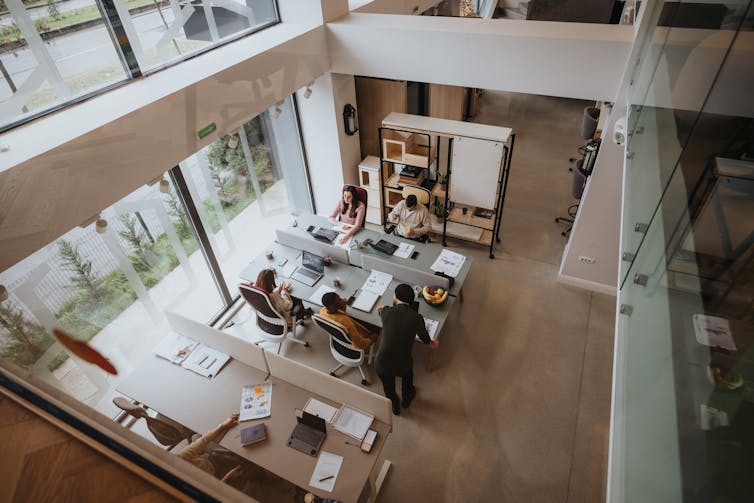
Better design: Office workers are asking for quiet areas and home-like comforts in the office. Shutterstock
Notably, the shift towards working from home has reshaped employees’ expectations. This has led to a decline in satisfaction with traditional office environments.
Despite the prevalence of remote work, a substantial portion of employees still operate from the same pre-pandemic workplaces.
As flexible work schedules become the norm, a shift in the notion of the workplace is underway. Spaces need to be designed not just for individual tasks, but to foster collaboration, innovation and social connections.
Job flexibility has become an essential feature that drives employee satisfaction and engagement. Employees surveyed say they want updated spaces that support both privacy and social interactions:
I do my best thinking in inspiring spaces. Natural light, spacious meeting rooms, modern furniture, quiet areas, sit/stand desks.
Another survey respondent explained:
It would be good to have more private spaces for online meetings, and also to escape from noise.
This change in employee expectations calls for new office builds with environments that enhance employees’ wellbeing. Workers are asking for features such as comfortable home-like spaces and health-conscious amenities.
The survey results show workers’ key post-pandemic design priorities include reduced density, physical distancing, reconfigured layouts and better ventilation.
To improve indoor environmental quality, facilities teams should adopt a holistic approach that combines improved air movement with advanced filtration systems for better air quality, workplace acoustics and greater employee control over environmental settings.
The workplace is under pressure to evolve into a dynamic, human-centered environment that supports both productivity and personal fulfilment. Many workers surveyed said they would be willing to move to a new office for a better office environment.







