


 Indonesia Plans Higher Asset Yields to Boost Rupiah and Restore Investor Confidence
  Malaysia Central Bank Moves to Support Ringgit Amid Foreign Fund Outflows
  South Korea Signals Possible Interest Rate Hike as Inflation Remains Elevated
  BOJ Signals More Rate Hikes as Inflation Risks Rise Amid Energy Price Pressures
  Taiwan Central Bank Likely to Keep Interest Rates Unchanged Through 2027
  ECB Keeps July Rate Options Open Amid Iran War Energy Price Risks
  BoE Policymaker Alan Taylor Signals No Need for Interest Rate Hike Amid Iran War Inflation Risks
  New Zealand Unemployment and Inflation Debate Intensifies Ahead of 2026 Election
  BOJ Rate Hike Expectations Rise as Weak Yen and Strong U.S. Jobs Data Increase Pressure
  RBI Holds Interest Rates at 5.25%, Cuts India Growth Forecast Amid Rising Global Risks
  ECB Set to Raise Interest Rates as Energy Shock Fuels Eurozone Inflation Concerns
  Jerome Powell Warns Against Politicizing the Federal Reserve, Defends Democratic Institutions


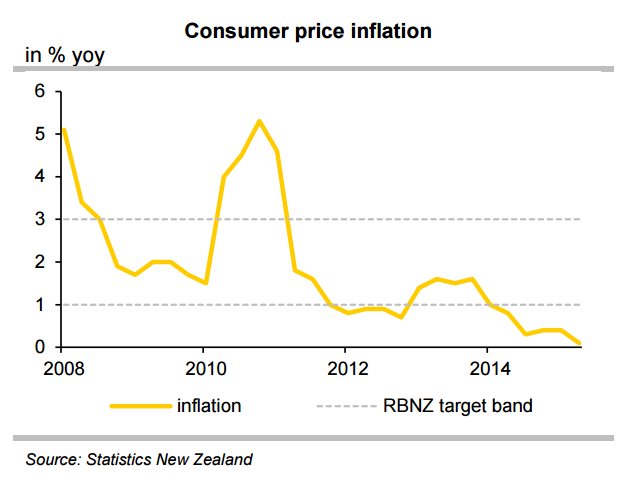
New Zealand's economy expanded more than expected in the fourth quarter of 2015, but the tepid inflation picture suggests more rate cuts from the central bank. New Zealand's GDP rose a seasonally adjusted 0.9 percent in Q4 versus the prior quarter and 2.3 percent on the year, data showed last Thursday. Data beat consensus for the economy to expand 0.6 percent on quarter and 2.0 percent on year.
However, weak Chinese economic outlook and the increased volatility on the financial markets is creating considerable headwinds for growth. Continued low milk prices are putting massive pressure on the terms of trade and as a result also on New Zealand’s global competitiveness. That said, outside of the dairy sector sentiment is considerably better. Low interest rates, high immigration levels, tourism and the continued strong activity of the building sector are driving domestic demand at present.
RBNZ surprised markets earlier this month with a decision to cut its official cash rate by 25 basis points to 2.25 percent, citing a material decline in a range of inflation expectation measures. The central bank's decision came despite the fact that the environment was generally more benign compared with the January meeting.
The main reason for the renewed rate cut is likely to have been the strong NZD, which is trading well above the levels the RBNZ considers justified in view of weak export prices. The central bank also signalled at least one more rate cut to come, should the return to the inflation target be dented by an excessively strong NZD.
In the final quarter of 2015 inflation disappointed notably. At 0.1% yoy it is well below the RBNZ’s target area of 1-3%. The continued or increasing downward risks for inflation caused by falling commodity prices and a recently stronger NZD are putting pressure on the RBNZ. In March trade weighted NZD traded more than 4% above the level the RBNZ had assumed in its Dec forecast indicating a risk to the inflation outlook. NZD/USD was trading at 0.6700 at 1100 GMT.







