


 Moscow Downs Dozens of Ukrainian Drones as Airports Halt Flights Amid Escalating Attacks
  Taiwan Launches Five-Day Combat Readiness Drill Amid Rising China Military Activity
  US Waives Iran Sanctions for 60 Days as Peace Talks Advance and Lebanon Sees Calm
  Cait Conley Wins Democratic Nomination, Sets Up Key House Battle Against Mike Lawler in New York
  Rubio Gulf Tour Aims to Reassure Allies on Trump’s Iran Deal
  Andy Burnham Emerges as Favorite After Keir Starmer Resigns
  Russia Signals Frustration Over Unfulfilled U.S. Commitments After Alaska Summit
  California Court Dismisses Trump Administration Lawsuit Against Los Angeles Sanctuary Policy
  UNAIDS Urges U.S. to Reconsider South Africa HIV Funding Withdrawal
  US Military Strike on Suspected Drug Trafficking Vessel Leaves Two Dead in Caribbean
  Lebanon Pushes Ahead With Israel Talks Despite Iran-U.S. Deal Impact
  Pedro Sanchez’s Wife Ordered to Stand Trial in Spain Corruption Case
  Trump Threatens ABC News Lawsuit Over Lincoln Memorial Reflecting Pool Coverage
  Japan, U.S. Discuss Yen Weakness as Currency Intervention Concerns Grow
  Trump’s Quantum Push Lifts IBM Stock as CEO Arvind Krishna Receives White House Praise
  Rubio Faces Gulf Skepticism Over U.S.-Iran Peace Deal
  Peru Election Dispute Deepens as Roberto Sanchez Rejects Runoff Results


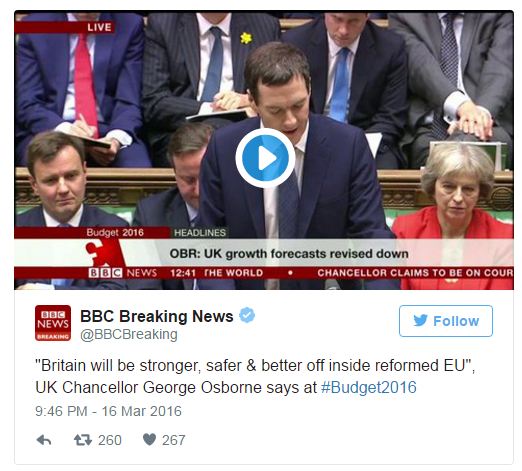
Twelve minutes into his “big statement” budget, Chancellor George Osborne made a strong plea for the British public to vote to remain in the European Union in the June referendum.
Citing the Office for Budget Responsibility, he argued that voting to leave would result in “disruptive uncertainty”. It would affect interest rates, the exchange rate, and possibly international investment decisions.
In fact, the OBR report is less robustly certain of the outcome of a potential Brexit vote than the chancellor suggested in his speech. It notes that the evidence is scant, and that any effects would take time to be felt, and would depend on the subsequent negotiation process.
There is certainly more rhetoric than hard fact in much of the business case for membership to date. However, the OBR’s assessment of the available evidence confirms that markets do not like the state of uncertainty surrounding Britain’s position on the EU.
Mood music
The chancellor’s eighth budget was squarely aimed at lifting business confidence and creating a more positive discourse about the state of the economy than we have heard from him over the past few months.
The purpose of this shift is not only to convince voters that the government’s plan is working, but also to help create the underlying mood music for a “remain” vote in June. Existing polling evidence suggests attitudes to European integration become more positive when voters feel the economy is doing well: optimism will win the day.

The emphasis on small businesses is also significant. They have emerged as more sceptical of the benefits of membership than large multinationals. The BBC has recently picked up on disquiet among small businesses, which previous Chambers of Commerce and other reports have been signalling for some time.
However, aside from the general mood music, the government’s commitment to EU membership has something of a hollow ring to it – and the same was true of the budget.
Osborne did not just refer to his engagement in favour of membership, but his commitment to a “reformed” EU. This discourse of reform begs the question of how the government is going to reform the EU, when the consensus around the February negotiations is that the prime minister was unable to make fundamental changes.
And it was particularly striking how little the EU seemed to matter to the government’s economic policy in this budget. The chancellor was happy to namecheck the OECD when he talked about clamping down on tax avoidance, but why not refer to the EU’s attempts to bring the multinationals to account?
The Conservatives have long sought to emphasise Britain’s strength as a go-it-alone economy. It featured heavily in the party’s pre-election manifesto and in most budgets before now. It would have been hard for Osborne to drop this narrative completely, but it seems more at odds than ever with a political commitment to EU membership.
 Susan Milner does not work for, consult, own shares in or receive funding from any company or organization that would benefit from this article, and has disclosed no relevant affiliations beyond the academic appointment above.
Susan Milner, Reader in European Politics, University of Bath
This article was originally published on The Conversation. Read the original article.







