


 Asian Stocks Plunge as AI Chip Selloff Hits South Korea and Japan
  Fed’s Hammack Says Bond Yield Surge Is Not Driven by Inflation Fears
  Trump Demands Powell Resign Over Fed Renovation Cost Overruns
  Samsung, SK Hynix Shares Plunge as China Chip Competition Grows
  Ethereum Foundation-Linked Wallets Move $11.13M in ETH to Kraken
  Trump Defends Russian Diesel Deal Amid US Sanctions Backlash
  BlackRock’s Rick Rieder Favors Bonds Over Stocks as Treasury Yields Surge
  US Dollar Rises for Fourth Week as Fed Rate Hike Bets Grow
  Wall Street Ends Mixed as Investors Await CPI and Bank Earnings
  Evernorth Nasdaq Listing Nears as XRP Price Falls
  Ripple-Backed Evernorth Set for Nasdaq Debut With 473 Million XRP
  US Dollar Near 18-Month High Ahead of Inflation Data
  NEAR Price Surges 11% as Trading Volume Doubles
  RBI Rate Hike Bets Surge as Inflation Rises
  XRP Ledger Foundation Confirms 100B Supply Safe After Security Fix


 Add as a preferred source on Google
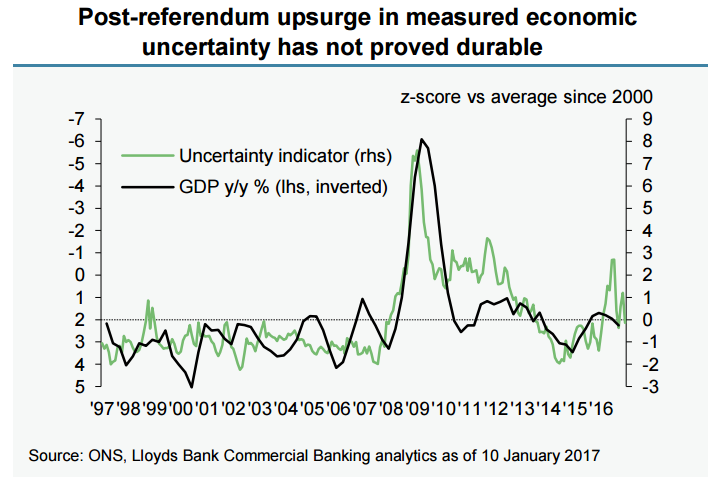
Incoming economic data in UK do not support the view of an uncertainty driven slowdown in the aftermath of the EU referendum. UK economy expanded at 0.6 percent q/q in Q3 2016, the first full post-referendum quarter. The economy’s dominant services sector saw a brisk 1.0 percent q/q growth in Q3.
Composite PMI in December spanning across the manufacturing, construction and services sectors stood at its strongest since July 2015. Survey data for Q4 have also been solid and analysts expect overall GDP growth in Q4 could post a 0.5 percent q/q rise. Together with the recent history of GDP data, that would leave growth in the six months since the referendum, in fact, quicker than in the first half of 2016. And the apparent resilience towards the end of 2016 suggests that some of this momentum is likely to carry over into H1 2017.
Inflation in the UK is likely to rise through 2 percent target by spring 2017 as currency weakness drives import price rises. The coming few months are likely to see a sharp rise in the headline inflation rate on the back of significant impact from energy price base effects and as the exchange rate pass-through becomes dominant.
"We expect CPI inflation to tick up further to 1.3% by December and burst through the 2% target by spring 2017. Easing underlying cost pressures from the second half of 2017 should provide some offset as growth in the economy slows modestly and reduced labour market tightness limits inflation’s overshoot relative to target." said Lloyds bank in a report.
As exit negotiations with the European Union begin, how measures of uncertainty evolve over the coming months and how strong the mapping proves with official activity data are among the key questions for the near-term outlook. The deceleration of economic activity over the course of 2017 and 2018 is likely to principally result from the weakness of sterling.
UK Monetary Policy Committee (MPC) is likely to look through inflation rise, but could react if activity slowdown proves more modest than expected. "Our base scenario sees Bank Rate on hold for the foreseeable future, but with a skew towards tighter policy," adds Lloyd's Bank in a report.
GBP/USD tests 1.21, weakest since Oct 7 'flash crash'. Cable continued slump as Hard-Brexit concerns continued to weigh on the investors’ sentiment. EUR/GBP spiked beyond 0.8750 to hit fresh multi-week highs at 0.8763.
FxWirePro Currency Strength Index showed Hourly GBP Spot Index at -91.9716 (Highly Bearish) at 1130 GMT. For more details on FxWirePro's Currency Strength Index, visit http://www.fxwirepro.com/currencyindex.







