


 U.S.-Iran War Update: Rubio Says Conflict Could End in Weeks as Strikes Escalate
  What does China’s host bid mean for the High Seas Treaty?
  Nepal's Ex-PM K.P. Sharma Oli Arrested Over Deadly 2024 Anti-Corruption Protests
  U.S. Praises Kurdistan's Role in Oil Markets Amid Iran War Fallout
  Russia and Iran Explore Diplomatic Path Amid Middle East Conflict
  God on their side: how the US, Israel and Iran are all using religion to garner support
  Elon Musk Announces Terafab: SpaceX and Tesla to Build Dual AI Chip Factories in Austin, Texas
  SK Hynix Eyes Up to $14 Billion U.S. IPO to Fund AI Chip Expansion
  China Opens Door to Stronger U.S. Trade Ties Amid Rising Tensions
  Chinese Universities with PLA Ties Found Purchasing Restricted U.S. AI Chips Through Super Micro Servers
  Trump's Signature to Appear on U.S. Currency Starting Summer 2025
  Meta and Google just lost a landmark social media addiction case. A tech law expert explains the fallout
  Golden Dome Missile Defense: Anduril and Palantir Join Forces on Trump's $185B Space Shield
  NASA's Artemis II Crew Arrives in Florida for Historic Moon Mission
  Ukraine-Russia War: Frontline Updates as Spring Offensive Looms
  Federal Judge Blocks Pentagon's Blacklisting of AI Company Anthropic


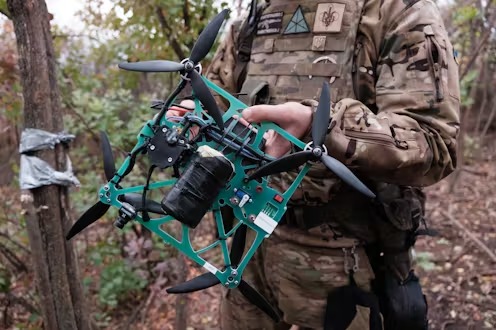
Ukrainian drone operators are increasingly relying on artificial intelligence to overcome the heavy signal interference that has become common along the front lines of the war with Russia. One Ukrainian pilot, known by his call sign Mex from the 58th Separate Rifle Brigade, recently described how a 20-kilometre drone strike on what appeared to be a Russian tank succeeded only because of an AI-assisted targeting system. According to him, hitting such a distant and well-protected target would have been impossible using manual controls alone, especially with Russian jamming devices saturating the area.
Over nearly four years of conflict, both Ukraine and Russia have dramatically expanded drone production, deploying millions of devices capable of surveillance and precision strikes. As electronic warfare has intensified, many drones lose contact with their pilots long before reaching their objectives. To counter this, Ukraine has increasingly adopted autonomous guidance tools that allow drones to lock onto visual targets captured by onboard cameras. Even if communication is cut, the drone can continue tracking and flying toward the designated target.
While Russia has introduced similar technology, the rapid integration of AI into drones on both sides has sparked global concern over the ethics of autonomous weapons. Despite the lack of binding international regulations, Ukrainian officials emphasize that final strike decisions remain firmly in human hands. Dozens of AI-enabled systems are already in use, with some integrated into thousands of drones across various units.
Mex explained that the system guiding his drone does more than follow a marked point on the map. It uses a trained “memory bank” of vehicles—including tanks, cars, and motorcycles—to help identify and pursue targets more accurately. He noted that even if he sets an initial aim point a few kilometers off, the AI adjusts during approach and aligns with the intended target. Industry experts say these tools continue to improve, though their success still depends heavily on battlefield conditions.







