


 Trump Administration Appeals Court Order to Release Hudson Tunnel Project Funding
  US Pushes Ukraine-Russia Peace Talks Before Summer Amid Escalating Attacks
  Bangladesh Election 2026: A Turning Point After Years of Political Suppression
  Trump Slams Super Bowl Halftime Show Featuring Bad Bunny
  Nicaragua Ends Visa-Free Entry for Cubans, Disrupting Key Migration Route to the U.S.
  Trump Backs Nexstar–Tegna Merger Amid Shifting U.S. Media Landscape
  Japan Election 2026: Sanae Takaichi Poised for Landslide Win Despite Record Snowfall
  Trump Allows Commercial Fishing in Protected New England Waters
  Israel Approves West Bank Measures Expanding Settler Land Access
  Taiwan Says Moving 40% of Semiconductor Production to the U.S. Is Impossible
  Trump Lifts 25% Tariff on Indian Goods in Strategic U.S.–India Trade and Energy Deal
  Sydney Braces for Pro-Palestine Protests During Israeli President Isaac Herzog’s Visit
  Anutin’s Bhumjaithai Party Wins Thai Election, Signals Shift Toward Political Stability
  Antonio José Seguro Poised for Landslide Win in Portugal Presidential Runoff
  China Overturns Death Sentence of Canadian Robert Schellenberg, Signaling Thaw in Canada-China Relations
  India–U.S. Interim Trade Pact Cuts Auto Tariffs but Leaves Tesla Out
  Trump Congratulates Japan’s First Female Prime Minister Sanae Takaichi After Historic Election Victory


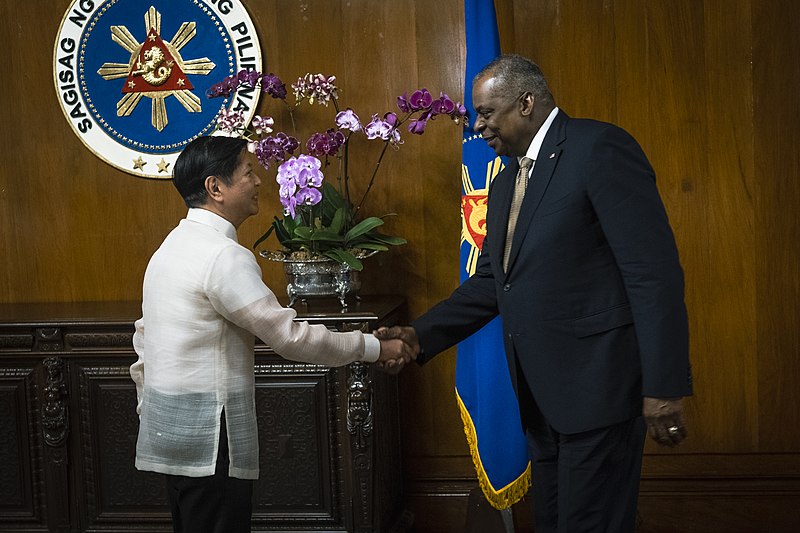
Philippine President Ferdinand Marcos Jr. said the additional military bases under the country’s defense agreement with the United States would be in various parts of the Philippines. The US was granted access to four additional military bases at a time when China is increasingly asserting its claims over the disputed South China Sea and the island nation of Taiwan.
Marcos Jr. told reporters at the sidelines of the anniversary of the founding of the Philippine army on Wednesday that the four additional military bases the US were granted access to under the Enhanced Defense Cooperation Agreement would be in various parts of the Philippines. EDCA gives the US access to Philippine army bases for joint drills, prepositioning of equipment and building facilities but is not a permanent presence.
“There are four extra sites scattered around the Philippines – there are some in the north, there are some around Palawan, there are some further south,” said Marcos Jr. The four additional sites were granted last month on top of five existing army sites under the 2014 agreement.
Marcos Jr. said that Manila and Washington would announce the locations of the bases soon and added that the sites would bolster the Philippines’ ability to defend the eastern side of Luzon, its largest island. Luzon is also the closest Philippine island to Taiwan, which China claims as its territory.
A former Philippine military chief previously said the US has asked for access to army bases in Isabel, Zambales, and Cagayan in Luzon, as well as Palawan, the island closest to the disputed Spratly islands in the South China Sea, which Beijing claims the majority of as its territory. Some local government leaders of the potential EDCA sites have opposed the decision out of concerns that the country would end up involved in a conflict should there be one between the US and the Philippines.
However, Marcos Jr. said his administration has discussed with them the importance of expanding US access and how it would actually benefit their provinces.
Last week, a senior US admiral warned that the current situation in the Indo-Pacific region was “trending in the wrong direction” and reiterated that the US presence in the region was not an effort to contain or incite conflict with China. US Indo-Pacific Command leader, Admiral John Aquilino, also referred to remarks by Chinese foreign minister Qin Gang that “conflict and confrontation” are inevitable unless Washington changes its stance and stressed the importance of making known that the US was not looking for a fight.
“There’s a place for China in this world to adhere and follow the rules like all the rest of us do,” said Aquilino.













