


 Wistron Opens $700M Texas AI Factory to Build Nvidia Superchips in U.S.
  ASML Trillion-Dollar Valuation: Can Europe’s AI Chip Giant Reach the Historic Milestone?
  Nike Shifts China Online Sales Strategy to Boost Brand and Fight Local Rivals
  Samsung Biologics Launches $1.81 Billion Bid to Acquire PolyPeptide
  Bank of America Says These Overlooked AI Stocks Could Be the Next Winners
  Why Maruti Suzuki Is Losing Market Share in India as SUVs and Premium Features Gain Popularity
  Super Micro Computer Stock Jumps 20% After Record AI Orders and Margin Surge
  SpaceX Targets Thursday Launch for Starship's 13th Test Flight After Last-Minute Delay
  Samsung Electronics America to Cut 739 New Jersey Jobs as Texas Headquarters Move Advances
  Ryanair Warns Summer Airfares May Stay Lower as Quarterly Profit Misses Estimates
  KKR, AEW Seek China Property Sales as Commercial Real Estate Slump Deepens
  TSMC Sees Multi-Year AI Chip Demand as Arizona Expansion Reaches $265 Billion
  SpaceX Q2 Earnings on Aug. 4 Set Stage for Historic Insider Share Unlock
  GM Q2 Earnings Beat Estimates as General Motors Raises 2026 Profit Outlook
  KPMG Australia Appoints John Sams as CEO Following Audit Leak Scandal
  South Korea’s Coupang Fine Sparks U.S. Criticism, Raising Concerns Over Bilateral Ties





Global warming is making weather patterns more extreme and increasing inequalities across regions. However, economic growth is still possible, with economies showing a range of responses to the impacts of global heating.
Recently, Martina Bozzola, Fabio Santeramo and I joined together to understand whether the climate crisis is creating new trading patterns. Our research concludes that international trade may serve as an adaptation strategy to climate change.
Production shifts induced by the changing climate may favour both the domestic and international markets depending on how interconnections across the globe facilitate the movement of goods. Taking into account conditions such as the geographical distance or the size of economies, the value of the exchange in goods between two trading partners is as large as their climatic conditions differ. Specifically, for an increase of 1 degree Celsius in the gap between the mean temperatures of two countries, the trade between them is expected to grow by 38% on average.
For example, between 1996 and 2015, the agricultural and food-related trade between India and Indonesia amounted to an average of 215 million dollars each year for the period. Indonesia is about 2 degrees Celsius warmer than India, and the effect of having a 1 degree Celsius larger difference in temperatures between the two countries would generate an average trade increase between them quantifiable in 82 million dollars per year.
Changes in temperatures leading to new shipping routes
The greater the temperature difference across countries, the tighter their commercial relationships get. In absolute terms, trade tends to increase more substantially for routes in the northern hemisphere, particularly when the European Union and the United States are involved: the intra-EU shipping routes are expected to increase annually by more than 1 billion dollars each. The monetary gain in the EU-US route is also relevant, rising from 611 to 893 million dollars more per year depending on the EU trading partner. While less marked, an increase in trade values is expected between countries in the southern hemisphere, including Latin America (for example, a rise of 552 million dollars between Argentina and Brazil) and Oceania (an increase of 573 million dollars between Australia and New Zealand).
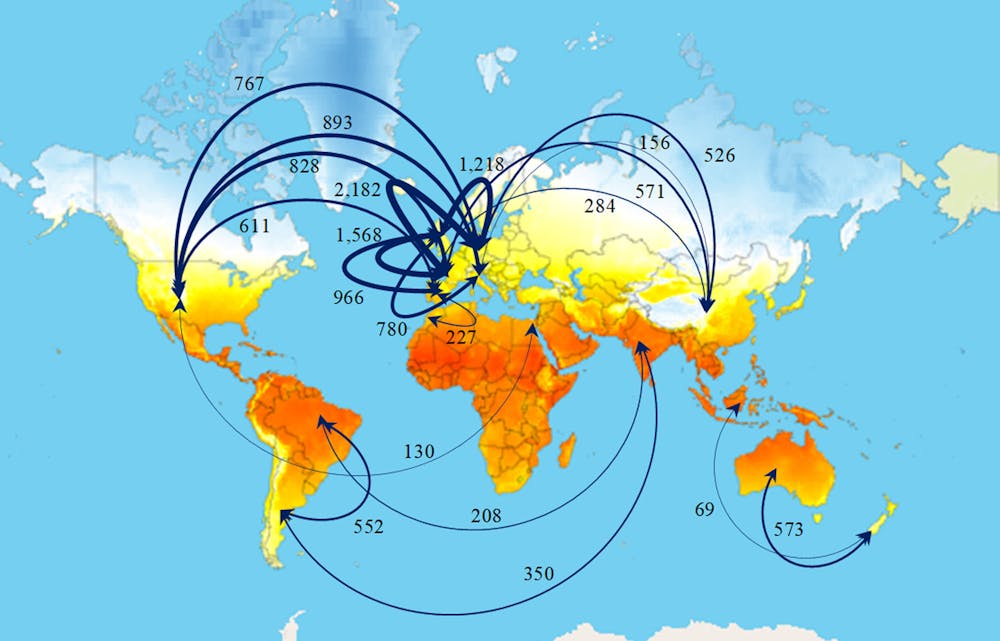
Top 20 trade routes most affected by increase in the difference between countries’ temperatures. Figures are in million dollars; the reference year is 2015. Fourni par l'auteur
The difference in the magnitude of trade effects between Northern and Southern countries is likely due to the variation in both the countries’ climates and state of economic development. Most of northern countries are developed economies, whereas most of southern ones are developing or emerging. Northern (developed) countries tend to have a colder climate and higher trade values with respect to the southern (developing) countries. Under the same increase in temperature differences, a higher level of economic development may explain the larger gains in monetary terms.
It should be kept in mind, however, that the strength of seasonality varies significantly across the globe, with seasons being more homogenous around the equator. Differences in temperatures tend to increase the value of agricultural and food products traded between lower-latitude countries, such as China, and higher-latitude countries, such as the EU. According to the data from Directorate-General for Agriculture and Rural Development of the European Commission, China is both a top origin and a top destination for the EU. On average, China is 6 degrees Celsius colder than the EU trading partners for the period between 1996 and 2015. Consistent with our results, such a difference would increase trade between the EU and China. Similar to other central Asian countries that traditionally suffered from a temperature penalty, China would benefit of an improved agricultural productivity with warmer temperatures.
Strategies to survive in a warmer environment
Climate change has a range of impacts across space, with some countries experiencing losses or gains more than others. Overall, changes in climatic conditions and increasing differences in the temperatures of countries contributes to change the economic geography and shape sectoral specialisations.
Countries shifting their specialisation is a form of adaptation that depends, among other, on their ability to trade with partners in other regions of the world. Developing trading partners with different specialisations would result in a potentially beneficial adaptation strategy to climate change.







