


 Asian Stocks Fall as Bond Yields Surge Ahead of Trump-Xi Summit
  Australia Unemployment Hits Five-Year High Despite Strong Jobs Growth
  US 10-Year Treasury Yield at 6% Emerges as New Market Risk Threshold
  Best Gold Stocks to Buy Now: AABB, GOLD, GDX
  Oil Prices Jump 3% as Houthi Attack Revives Supply Fears
  US, China Extend Trade Truce to Jan. 10 Ahead of Trump-Xi Summit
  Oil Prices Ease as Iran Tensions Clash With Diplomacy Hopes
  RBI Uses $10 Billion Currency Swaps to Drain Excess Rupee Liquidity
  Asian Stocks Fall as Surging Bond Yields Rattle Markets
  South Korea, US Discuss Warship Building Cooperation


 Add as a preferred source on Google
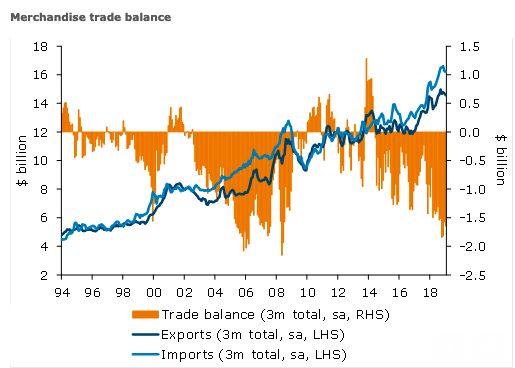
New Zealand’s trade balance for the month of January came in considerably weaker than market expectations with exports below expectations and imports considerably stronger. Exports are expected to pick up in the coming months as more meat and dairy products start to flow out of the country, according to the latest report from ANZ Research.
The unadjusted monthly trade balance turned a large deficit of $914 million in January. Exports at just $4.4 billion were below expectations with the slow start to the meat processing season primarily to blame. Imports were strong, partially due to a $200 million large item, but the overall import strength indicates domestic demand remains robust.
On a seasonally adjusted basis, exports decreased 7.8 percent m/m. Dairy volumes lifted, but the recent uptick in dairy prices is yet to be reflected in export values. Meat volumes were down 6.2 percent which combined with slightly weaker prices pulled the value of this export category down 8.8 percent. Strong prices for logs offset a sharp reduction January export volumes which were down 25.3 percent.
Seasonally adjusted imports rose 0.4 percent m/m. Petrol imports dropped by 6.1 percent following a strong lift the previous month. Textiles imports lifted 29.3 percent, more than offsetting the sharp drop in December. Imports of optical and medical goods lifted sharply, up 16.7 percent m/m in January. There was also a large item ($200 million) boosting an already robust print for monthly imports.
On a regional basis, exports to China maintained their positive trend, up 15.2 percent in the year to January. However a sharp drop in exports to Australia was recorded in January, although on an annual basis exports to this market are still slightly stronger.
"The annual deficit is expected to narrow as the year progresses reflecting stronger export volumes of meat, dairy and forestry, while the improvement in prices for dairy should start to flow through in the coming months," the report added.
Image courtesy: ANZ Research







