


 Dollar Near Two-Week High as Stock Rout, AI Concerns and Global Events Drive Market Volatility
  Anutin’s Bhumjaithai Party Wins Thai Election, Signals Shift Toward Political Stability
  SpaceX Pivots Toward Moon City as Musk Reframes Long-Term Space Vision
  Trump Slams Super Bowl Halftime Show Featuring Bad Bunny
  Lee Seung-heon Signals Caution on Rate Hikes, Supports Higher Property Taxes to Cool Korea’s Housing Market
  DBS Expects Slight Dip in 2026 Net Profit After Q4 Earnings Miss on Lower Interest Margins
  Dow Hits 50,000 as U.S. Stocks Stage Strong Rebound Amid AI Volatility
  Japan Economy Poised for Q4 2025 Growth as Investment and Consumption Hold Firm
  Nicaragua Ends Visa-Free Entry for Cubans, Disrupting Key Migration Route to the U.S.
  Asian Currencies Stay Rangebound as Yen Firms on Intervention Talk
  Trump’s Inflation Claims Clash With Voters’ Cost-of-Living Reality
  South Africa Eyes ECB Repo Lines as Inflation Eases and Rate Cuts Loom
  Bank of Japan Signals Readiness for Near-Term Rate Hike as Inflation Nears Target
  U.S. Stock Futures Rise as Markets Brace for Jobs and Inflation Data
  Israel Approves West Bank Measures Expanding Settler Land Access
  Indian Refiners Scale Back Russian Oil Imports as U.S.-India Trade Deal Advances


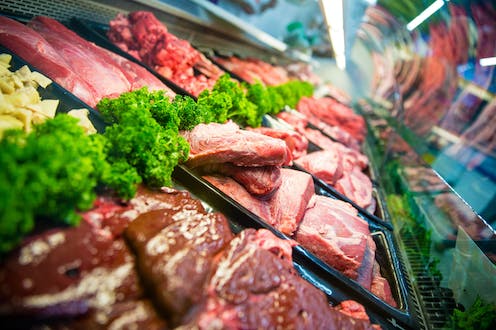


No prominent UK politician has proposed taxing meat, despite government ministers insinuating it is Labour Party policy. Levels of meat consumption are a problem though. And while Conservative MPs might assume it’s a proposition the public would baulk at, research on the feasibility of meat taxes isn’t so clear-cut.
Eating large quantities of red and especially processed meat is unhealthy and increases your risk of developing a number of diseases. Public sentiment overwhelmingly condemns the intensive animal farming practices that generate cheap meat products – even if that concern does not always translate into fewer purchases (researchers have dubbed this the “meat paradox”).
Livestock farming contributes to numerous environmental problems, from deforestation and biodiversity loss to pollution and climate change.
But when a meat tax is suggested to stem these problems, by reducing meat demand and financing more sustainable alternatives, such a policy tends to be interpreted as an assault on consumer freedoms or hard working taxpayers.
In new research, we investigated two claims that are often made in the political debate: that a meat tax necessarily harms low-income households and that introducing one is politically impossible. We found that neither stands up to scrutiny.
Not so taxing
Is a meat tax unfair? Since low-income households spend a larger share of their earnings on food, taxes on meat might be expected to hit them harder.
But whether a tax disadvantages poorer households ultimately depends on how the revenues it raises are used. Channelling it back to consumers in monthly or annual payments directly to their bank accounts, similar to the idea of paying out “climate dividends” from money raised by taxing carbon emissions, would mean poorer people benefit on average.
That is because richer households spend more on meat in absolute terms. Hence, they contribute more to the common pot of revenues that is then shared equally between everyone – as a result, most people on low incomes would have more money than before the tax reform.
Lowering value-added taxes on fruit and vegetables, under discussion in a few European countries, lessens the burden on low-income consumers, although it does not reverse it completely, which is why redistribution is necessary.

Meat and dairy are more heavily subsidised in the EU than fruit and vegetables. New Africa/Shutterstock
Our research found that meat tax rates set at levels comparable to those of carbon pricing in the UK power sector have a very small effect per person, amounting to extra expenditure of less than £10 a month on average.
In any case, price interventions on meat and other emissions-intensive foods are probably needed to meet environmental targets in the food sector. And ensuring they are designed to benefit the under-resourced could be crucial for garnering sufficient support.
Package sensibly
Is a meat tax politically impossible in the UK? Actually, other industrialised countries, facing the same problems with levels of meat consumption, are already doing or planning to do something similar.
New Zealand, where approximately half of all greenhouse gas emissions come from animal agriculture, will price emissions in this sector from 2025, effectively introducing a tax that will predominantly increase the price of meat products.
Unfortunately, the meat industry is no different from the tobacco or oil industries when it comes to spreading misinformation. One study found organisations representing the UK meat industry had led the public astray using a number of framings in their public communication strategies.
These were: “the harmfulness of meat consumption is still open for debate” (it isn’t); “most people need not worry about the health risks” (they should); “you should keep eating meat to be healthy” (there’s no need); “there is no need to cut down on how much meat you eat to be green” (there is).
Public aversion to government intervention on meat is understandable in this context. And consumers alone should not shoulder the burden of making the food system more sustainable.
Fortunately, research shows that it is still possible to win over the public with clever policy packaging. For example, survey data shows financing higher animal welfare standards and phasing out subsidies for environmentally harmful farming practices could sway public opinion on price interventions on meat products.
Other countries have followed this strategy. In Germany, there is strong public demand for improving animal welfare.
A government commission there recommended an animal welfare levy – a uniform tax on all meat products, with the proceeds to be spent on raising livestock rearing standards. Research indicates that, for Germans, animal welfare is a more compelling justification for introducing meat taxes than climate change.
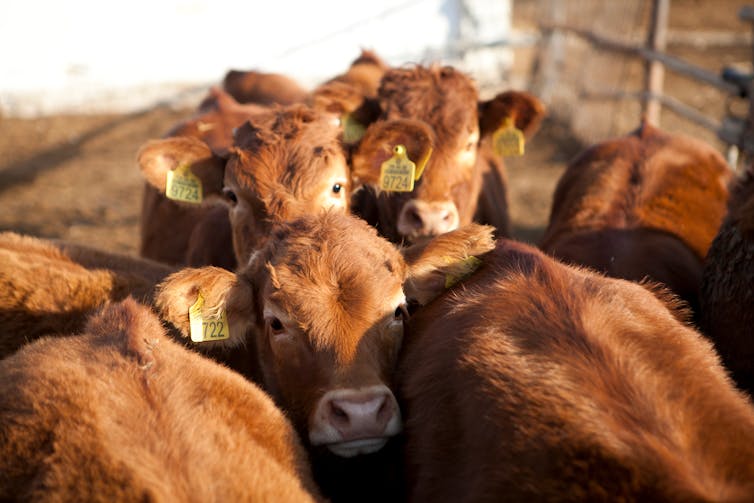
Public desire to improve animal welfare standards trumps climate motives. Ehasdemir/Shutterstock
In Denmark, a transition to plant-based diets is not seen as particularly controversial. The parliament recently passed a roughly £80 million fund for developing and promoting plant-based foods.
In the UK, a sugar tax on soft drinks was passed and proved successful in cutting sugar consumption. This shows there is no political barrier to making a meat tax work if political parties allow a sober and nuanced debate on this issue.
To make the cuts to meat consumption required for better public health, greater animal welfare and a stable climate, taxing meat in some form is inevitable. To make such a measure more palatable, a winning formula would deliver on public demand for higher animal welfare standards, redistribute the revenue to benefit low-income consumers and shift farming subsidies towards fruit and vegetables.
And let’s think of a different name for it. An animal welfare levy, or sustainable farming levy, might just work.













