


 Bangladesh GDP Growth Accelerates to 4.6% on Industrial Rebound
  Wall Street Falls as Fed Minutes Signal Another Rate Hike
  Gold Prices Rise as Dollar Weakens, Treasury Yields Fall
  Fed Minutes Signal Another Rate Hike by Year-End
  US Stock Futures Flat as Fed Minutes, Earnings Loom
  Oil Prices Slip as Trump Rules Out Iran Strike Before Midterms
  Deere, CNH and AGCO Stocks Fall as FTC Launches Farm Equipment Probe
  Gold Prices Fall as Fed Signals Another Rate Hike
  RBI Raises Repo Rate to 5.50% in Hawkish Shift on Inflation Risks
  Gold Prices Rise as Hormuz Tensions Fuel Inflation Risks
  Oil Prices Rise as Gulf Hurricane and Middle East Supply Risks Mount
  Trump Secures Russian Diesel Deal as US Fuel Prices Surge


 Add as a preferred source on Google
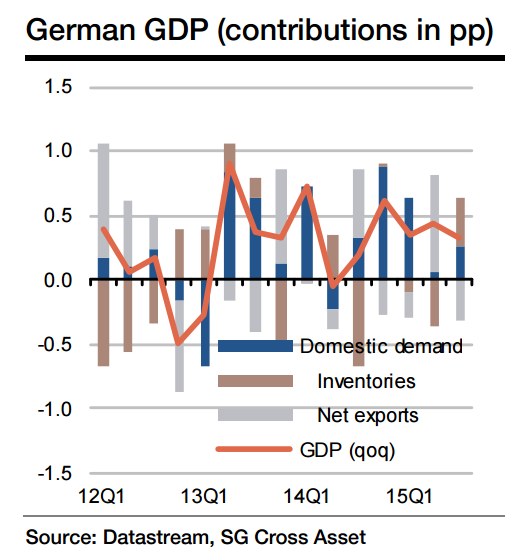
In Q3, German GDP grew by 0.32% qoq, according to the preliminary release, which compared with 0.44% in Q2 and was lower than the 0.36% forecast. This week's release will provide the first breakdown of growth, which should confirm that domestic demand is back as the key driver of growth, after net exports were the dominant driver in Q2.
Private and government consumption is expected to have increased by 0.4% and 0.3% qoq, respectively, while net exports should have made a negative contribution. According to the qualitative information in the flash release, investment is likely to have been the main reason for the weaker-than expected GDP growth. Contrary to the expectation of a rebound, investment appears to have declined slightly.
Looking to Q4, while further headwinds are expected to trade and investment stemming from the weaker global outlook, consumption should remain buoyant, in line with the strong labour market and increased fiscal spending in relation to the high refugee inflows.

- News

- Economy

- Central Banks
- Investing
- Research
- Roundups
- Digital Currency
- Insights
- Technical Analysis
- Technology
- Business
- Law
- Health
- Nature
- Fintech
- Science
- Topic
- Opinions
- ©Econometrics LLC . All Rights Reserved.
German domestic demand back on track in Q3
Monday, November 23, 2015 11:15 PM UTC
Editor's Picks



- Market Data
Most Popular




