


 Best Gold Stocks to Buy Now: AABB, GOLD, GDX
  Fed Unveils Stablecoin Rules Under GENIUS Act
  Japan Private-Sector Growth Slows as Domestic Demand Weakens
  FxWirePro: Daily Commodity Tracker - 21st March, 2022
  Fed Unveils Stablecoin Rules Under GENIUS Act
  RBI Uses $10 Billion Currency Swaps to Drain Excess Rupee Liquidity
  Oil Prices Jump 3% as Houthi Attack Revives Supply Fears
  Fed’s Hammack Says Bond Yield Surge Is Not Driven by Inflation Fears
  Asian Stocks Fall as Bond Yields Surge Ahead of Trump-Xi Summit


 Add as a preferred source on Google
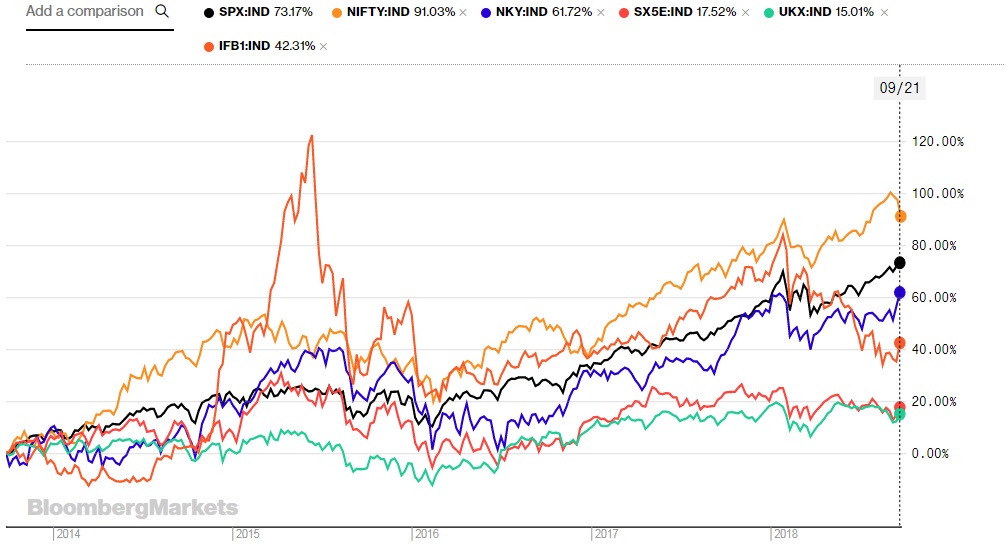
As the U.S. economic and foreign policies decouple from the rest of the world (President Trump’s stance on Jerusalem, NATO, Iran nuclear Agreement, Trans-Pacific Partnership, Paris Climate Accord), so do its economy and financial markets. After decades of globalist policies, under president Trump, it has taken a sharp turn towards nationalism and protectionism.
So far, it has been working out fine for the United States. U.S. economic growth hit 4.2 percent last quarter and Fed’s ‘GDP Now’ data shows that it was not a one-time event. The next quarter could be even better. This comes at a time when Europe is still struggling and weakness is visible in many emerging market economies.
Similarly, U.S. financial markets have been decoupling from the rest of the world. So far in 2018, the U.S. benchmark stock index has returned +8.3 percent, whereas India’s nifty has returned +5.1 percent, Nikkei has returned +1.9 percent, Eurostoxx50 has returned -2.3 percent, same as FTSE100, and China’s benchmark CSI300 has returned -17.4 percent. This might seem just another outperformance, the trend is becoming more and more visible. And we believe that it is here to stay.







