


 Japan Government Backs Earlier BOJ Rate Hike as Inflation Pressures Build
  U.S. Banks Report Strong Q4 Profits Amid Investment Banking Surge
  Goldman Predicts 50% Odds of 10% U.S. Tariff on Copper by Q1 Close
  Global Markets React to Strong U.S. Jobs Data and Rising Yields
  RBA Signals More Rate Hikes Possible as Australia Battles Stubborn Inflation
  Indonesia Surprises Markets with Interest Rate Cut Amid Currency Pressure
  Singapore Central Bank’s Exchange Rate Policy Explained: Why MAS Uses the S$NEER Instead of Interest Rates
  U.S. Treasury Yields Expected to Decline Amid Cooling Economic Pressures


 Add as a preferred source on Google
Why doesn’t PBoC fix a neutral USDCNY rate? It is comprehensible that the PBoC intended to guide its currency stronger when everyone expected to see a rapid CNY depreciation, which was the idea behind the “counter-cyclical factor”. However, although the market has become much more neutral on its yuan outlook now, the USDCNY fixing still tends to surprise on the downside, which happened this morning again.
Hedging the “red line”: Logical hedge to North Korea is long USDKRW or long JPYKRW, but won options are pricey. China is unlikely to be safe haven asset.
Hedging extended price action: CNH would weaken alongside a correction in the EUR (positioning elevated, expensive vs real rate differentials).
Hedging a growth slowdown: An earlier or larger Chinese growth slowdown could alter current bullish positioning.
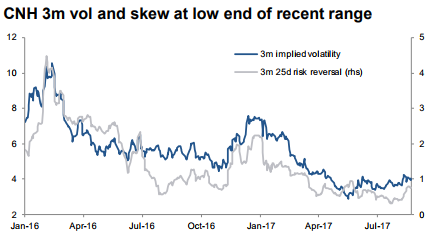
Vol parameters: Current parameters (skew and convexity) are generally conducive to owning volatility and positioning for the possibility that the recent strength is partially reversed.
Hence, we advocate buying USDCNH 3m call strike 6.83. Entry level (date): 0.41%, spot ref: 6.69 (May 18 2017) Maximum loss limited to premium paid.
USDCNH and implied vol is marginally below our entry level; use as a hedge against North Korea risks, EUR correction, and for portfolios that are short dollars and long carry such as our own.
Risks & what to watch for:
USD dynamics and leadership changes: Capital outflows are minimal, so CNH might need to adjust alongside a broader dollar move. Also, there is a risk that the authorities promote FX strength ahead of the leadership changes in late October.







