


 BlackRock’s Rick Rieder Favors Bonds Over Stocks as Treasury Yields Surge
  BOJ Set for Rate Hike as Inflation and Yen Pressure Mount
  Bank of America Posts Strong Q4 2024 Results, Shares Rise
  Central Banks Could Buy 20,000 Tonnes of Gold: BofA
  Moldova Criticizes Russia Amid Transdniestria Energy Crisis
  Yen Sinks as BOJ Rate Hike Fails to Impress Markets
  Geopolitical Shocks That Could Reshape Financial Markets in 2025
  Gold Prices Slide as Rate Cut Prospects Diminish; Copper Gains on China Stimulus Hopes
  Fed’s Hammack Says Bond Yield Surge Is Not Driven by Inflation Fears
  Indonesia Surprises Markets with Interest Rate Cut Amid Currency Pressure
  Energy Sector Outlook 2025: AI's Role and Market Dynamics
  Fed Unveils Stablecoin Rules Under GENIUS Act
  RBI Uses $10 Billion Currency Swaps to Drain Excess Rupee Liquidity


 Add as a preferred source on Google
Only a few analysts had expected the SNB to cut its key rate at today's meeting. But, the Swiss central bankers maintained the status quo in their monetary policy to keep rates unchanged at -.75%. However, another aspect of today's SNB decision is more interesting. The SNB eased the burden for banks that result from the negative-rates policy.
So far, the exemption threshold for banks' SNB deposits was 20 times the average minimum reserves of autumn 2014. Two adjustments have been made to this rule:
- The threshold factor has been increased from 20 to 25.
- And the reference period for reserves is now dynamic. It is the average of the last 36 reference periods and therefore will now reflect the rise in reserve requirements that occurred during the last five years - and the one that might come in the future.
That by itself is easing the burden on Swiss banks that results from the extreme negative-rates policy, which now exists for nearly five years.
Swiss franc (CHF) has been a relative underperformer this month, retracing about a quarter of its 6% May-August rally as risk sentiment has somewhat improved of late – but we remain bullish, OTC updates are also in sync with the projections:
Driving these moves lower were a few factors:
1) tentative signs of stabilization in activity data (as indicated by the headline manufacturing PMIs),
2) a restart of US-China trade talks with a small postponement of tariffs, and
3) clarification on the extent of policy easing that China will deliver. Still, these developments are far from fully resolved; the data has not clearly bottomed, and ongoing US-China uncertainty should continue to adversely affect the manufacturing complex, which should continue to weigh on growth globally and thus underpin CHF on a more medium-term basis.
OTC Updates and Options Strategies:
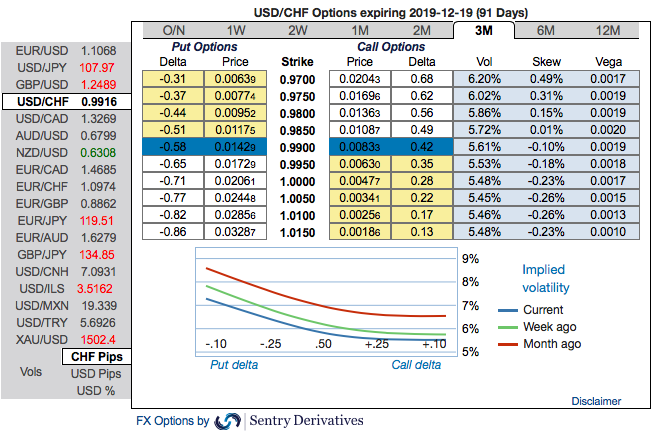
Let’s just quickly glance through OTC updates before deep diving into the strategic frameworks of USDCHF. CHF crosses are showing shrinking IVs among G10 FX bloc (1m IVs are at 5.4 for USDCHF). Butterfly options spreads are suitable amid this lower vols environment.
IV factor is highly imperative in FX option dynamics because the option pricing significantly depends on future volatility, and it is quite impossible for any veteran to ascertain accurate future volatility.
Most importantly, positively skewed IVs are still advocates of downside risks. Please also be noted that the minor positive shift in risk reversals (RRs) of across all tenors and bearish RRs of the longer tenors that are also in sync with the bearish scenarios refer 2nd(RR) nutshell.
Accordingly, diagonal put spreads are advocated to mitigate the downside risks with a reduced cost of trading.
The execution: Short 2w (1%) OTM put option with positive theta (position seems good even if the underlying spot goes either sideways or spikes mildly), simultaneously, add long in 2 lots of delta long in 3m (1%) ITM -0.79 delta put options.
On trading grounds, executing below options strategy as IVs are most likely to favor.
So, buy OTM -0.49 delta put while short ATM put with similar expiries, simultaneously buy OTM 0.5 delta call while simultaneously shorting an ATM call with similar expiries. This strategy is structured for a larger probability of earning a smaller but certain profit as USDCHF is perceived to have low volatility. Courtesy: Sentrix, Saxo & Commerzbank







